
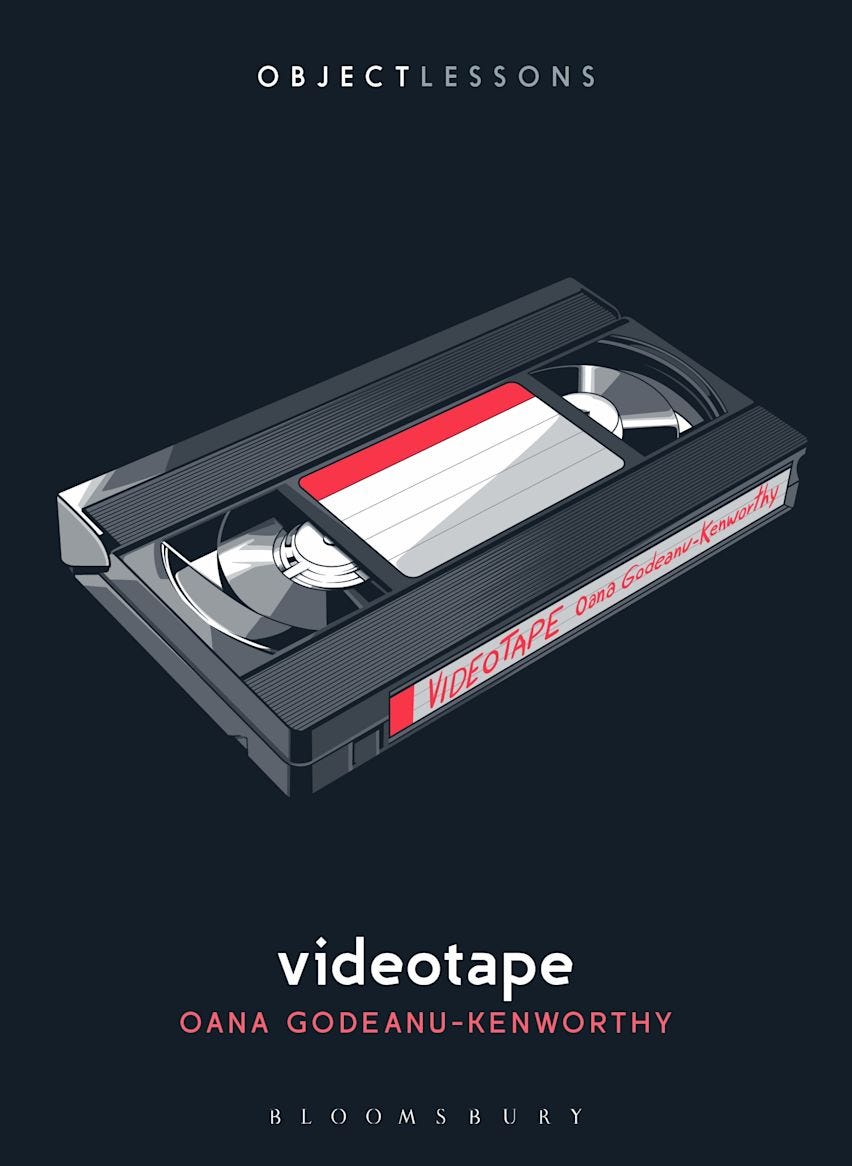
Object Lessons: Videotape
Oana Godeanu-Kenworthy

“Objects have the longest memories of all. Beneath their stillness, they are alive with all the experiences they have ever witnessed.”
Teju Cole
Object Lessons, published by Bloomsbury Books, is an illuminating series of short, beautifully designed books about the hidden lives of ordinary things. As Godeanu-Kenworthy’s incisive biography of this impactful technology reveals, over the span of a single decade, the VHS format changed the privileged relationship between privacy and entertainment, pried open the closed societies behind the Iron Curtain, and then mysteriously sank back into oblivion. Although what we now call streaming has assumed prominence, the legacy of the humble videotape still continues to inform modern entertainment. And I’m delighted to say that both Godeanu-Kenworthy and I appear to share a similar, if not parallel, fondness for the technology that preceded our present stream-mad dimension. Here’s my outset admission: I’ve always been a huge fan of the analog world, its haptic tone and the various shapes it took, and I sill am. The author of this charming little book, which has a giant subject and theme that belies its scale, also shares in her book’s beginnings what might account for her fondness. Our first exposure to any given medium of expression is often the most impactful on our successive modes of experience.
The author’s captivating salvo positions us at the crux of what made and makes videotape so memorable, at least for those of us with memories still activated to its unusual frequency. She recounts her first movie on tape, watching it with her family in the living room of a vacation home in a Romanian resort on the Black Sea with a group of tourists staying in the same house. They owned a VCR and one evening pulled out and popped in Return of the Jedi, and she was overcome by the thrill of being in a darkened room with strangers (not unlike a movie theatre in fact) and witnessing the wild pop mythology unfold together, enjoying what she called “the delicious thrill of the communal forbidden vacation experience.” My own first video experience was similarly a shared family setting, watching the film noir classic Sunset Boulevard, mostly because my parents explained to me that it was a classic Hollywood film co-written and produced by a family relative, Billy Wilder’s creative partner Charles Brackett, from the golden age. From that rainy day experience on, I was, like the author of this enchanting and informative Object Lessons book on Videotape, a captive audience forever.
The author veers effortlessly from the personal to the professional, in a candid manner which clearly indicates that like me, she at one point encountered the zone of transformative change: when videotape transitioned from being a communication tool to being a cultural fetish object: “When the lights came back on, our host pushed a button to rewind the tape, and then ejected it. I remember taking the cassette in my hand. It was still warm, felt heavy and solid, and gave off a faint chemical smell. Inside the transparent window, right under the word VHS, I could see the brown spool of tape that hid Yoda and Luke Skywalker. What I did not realize at the time was that the presence of that videotape in the small Black Sea resort was the result of an improbably global adventure as exciting as anything the Star Wars universe had to offer. It involved an evil empire, an epic battle of (tech) giants over a new technology, governments that tried to control it, lobbyists, spies, blockades, traders and smugglers.” She then swiftly, in 128 well written and tightly delivered pages, takes us on a truly whirlwind tour of the Videotape chronicle. It’s a vertiginous roller coaster ride through a pop culture era which some of us remember fondly, while other are left bewildered by what they perceive as merely an antique artifact.
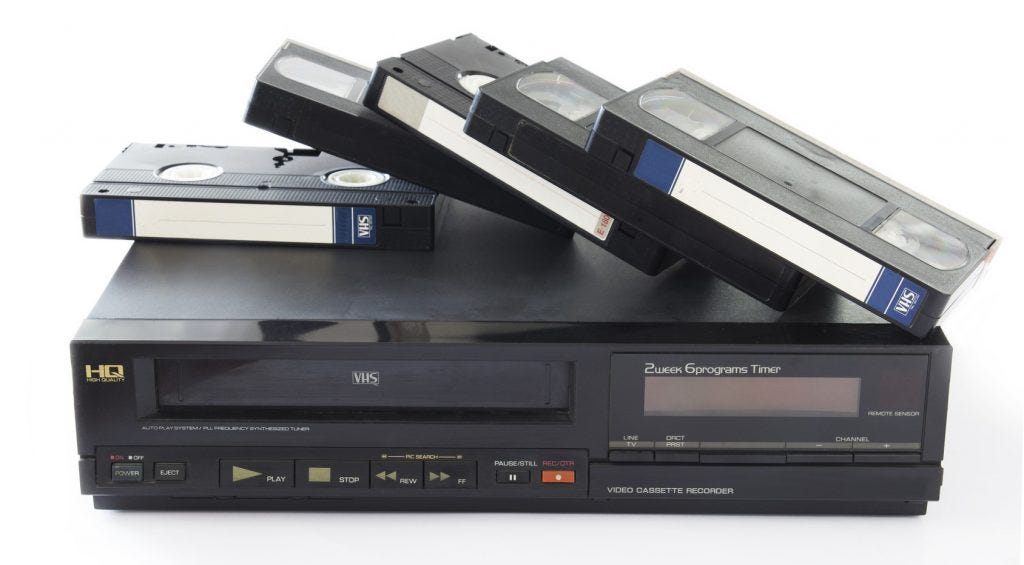
Future Relics
I call her documentary tale a biography because the object in question did have a definite personality and defining character, one that in turn defined an entire historical epoch: “Invented in Japan, popularized in North America and which soon took over the world, the Betamax-VHS format war; the Supreme Court decision that decided that recording content did not infringe upon intellectual property rights; the global boom in porn and horror; the gradual shift of movie consumption from the theatre into the home; and the rise—and fall—of the family friendly video store. As the technological Trojan Horse for Hollywood fare, the popularity of video triggered visceral reactions.” Those reactions are also detailed in an entertaining manner: the launching of campaigns against horror films, the unlikely anti-porn alliance between US feminists and Christian conservatives, and the socialist regimes beyond the Iron Curtain (the rise and fall of videotape roughly overlapped with the final decade of the Cold War) first tried to control the new technology and eventually attempted to completely co-opt its flexible format to their own political and ideological ends.
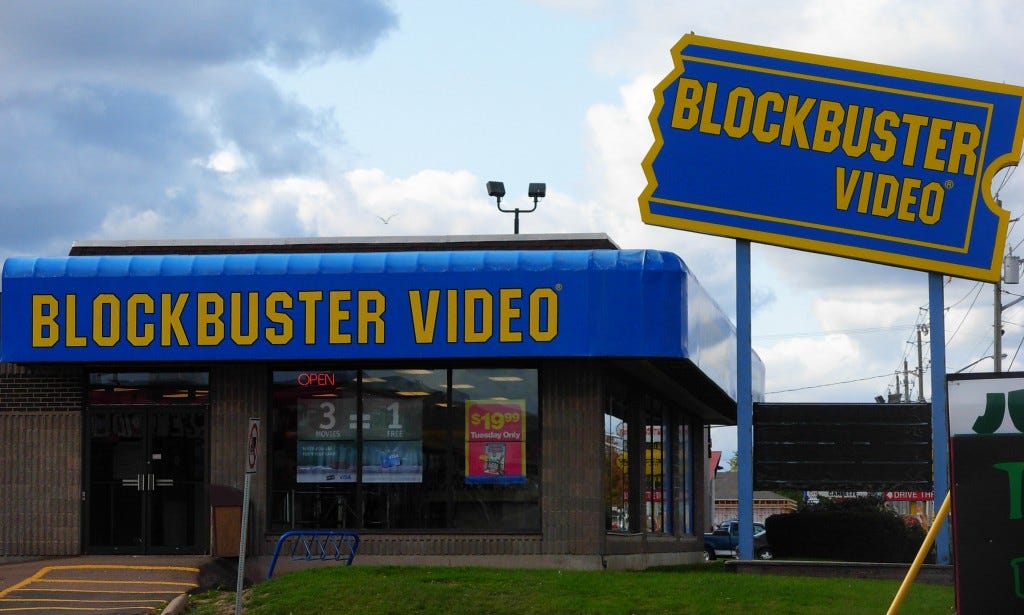
A Past Mirage.
The images circulated on videotape were watched both legally and illegally and quickly manifested new business models to profit from them, since it was obviously a huge boon to capitalist consumption during drastically changing times. “The precipitous decline of the VHS tape in the 1990’s is a testament to how ephemeral content can be in the face of technological change. In 2016, Funai, the last producer of VCRs, stopped production, signaling the end of the video era.” I’m reminded of that cheeky pop song from 1981, “Video Killed the Radio Star” by the Buggles, which was used to launch the then new MTV network, and am certain that there must be a similar anthem somewhere about how “Streaming killed the video star.” This is the case because the author reminds us that what used to be a vibrant medium is now an ‘oddity’, what she calls a “subculture of nostalgia, an anachronistic preference in an age of streaming.” Perhaps Taylor Swift is working on such a new anthem.
But she also reminds us, equally astutely, that a lot has been lost in the transition to digital (not least of which is the fact that only a fraction of content was ever transferred to digital) and that “Once their techno-ecosystem had gone extinct, the materiality of the tapes, so reassuring and concrete, turned out to be as useless as a Netflix plan with no Internet available.” And that is the principal importance of her book, which dwells affectionately on the object of tape itself, and what Teju Cole referred to as a deceptive stillness, beneath which it has witnessed a multitude of experiences which we can now only access in our own personal and fading memories. She really is studying a shifting ‘techno-ecosystem’, an alluring term indeed, and also a succession of rapidly accelerating historical moments which show no sign of ever slowing down. But there are still some us, call it a cult if you like (the original name for rituals of looking that birthed visual art and its persistent aura in the first place) for whom the physical dimension of ‘things’ is still somewhat precious.
Who could have predicted (apart from HG Wells of course) way back before the Internet even existed as a concept, that we might eventually occupy, via technics (the original and official word for technology) a world where we are interconnected through a threshold-breaking mechanical means which starts out as a benevolent helper but invariably ends up virtually colonizing our very definition of reality itself. I have long been a proponent of analog forms of art and entertainment, and even bemoan to friends what we have lost from the 20th Century formats and motifs which are receding ever faster in the rear view mirror as we hurtle full-throttle into a future commandeered, and even to some extent HR-managed, by machines with continually more sophisticated delivery systems for their content. So much so that we can often lose sight of the fact that the actual aesthetic content, which are most often expressions of human longing or regret, hasn’t really changed that much over generations of systematic delivery and only the digital platter on which the sensory information is being served has altered. I suspect it will still be being transmuted long into the 22nd century, although probably mashed into a new style format by some audacious new Artificial Intelligence vehicle or other.
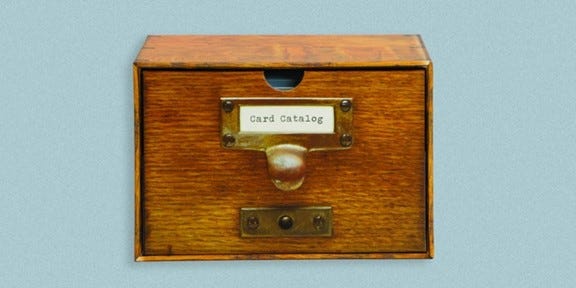
Our original streaming device.
In Analog, by Robert Hassan, the author also asked us to consider a salient question: “Why, surrounded by screens and smart devices, do we feel a deep connection to the analog form, to books, vinyl records, fountain pens, Kodak film, and other nondigital tools?” And David Sax (author of The Future is Analog) observed that “The digital future, we’re assured, is only a matter of time. But we become lost when we try to replace the human with the digital. The full-body roller coaster that is human existence on planet earth: when we try to replace that reality with a digital facsimile, we are lost. Basically, the future is analog, because we ourselves are analog. Humans have genuine social needs and if those needs aren’t met, we will actually perish. For the past few years we have overdosed on digital. Now, we’re reckoning with an epic hangover. We face a choice, strap on our headsets, double down, and plunge deeper into the metaverse. Or step back, reconnect to our bodies and the world and find a way to build a more human future.”
This is also the realm of both artistic and sociological reflection being explored by Godeanu-Kenworthy in this modestly grand Object Lessons tome on Videotape, her highly accessible and entertainingly concise guided tour of how we got to where we are and why we need to actively appreciate more cogently what the analog domain really was, and still is, rather than pompously imagining it as something antique to be left behind. In a kind of summation section, ‘Nostalgia and the VHS Aesthetic’, she asks the obvious question lurking behind her book, ‘The Videotape Today: Why Care?’ and accurately reminds us that “The legacy of videotapes is everywhere, embedded in our social practices, in the technological arrangements we take for granted, and even in the aesthetic choices that shape our media consumption. Material remains can serves as ‘testimonial objects’ that allow us to focus crucial questions both about the past itself and about how the past comes down to us in the present.” My favourite questions pondered by this author relate to vinyl records, a technology that I still cherish for its haptic qualities as well as its superior sonic immersion, especially when experienced in glorious mono rather than the flimsy marketing gimmick of ‘stereo’ (have a listen to the early mono vinyls of the Beatles, Stones and Dylan to confirm this wild assertion for yourselves).
“Will videotapes have a revival similar to that of vinyl records?” she asks. “It’s hard to say, especially because as a medium, the magnetic tape has a limited life. Yet what is having a revival is the VHS aesthetic, the look and feel that evoke the fragility and flaws of the medium.” This is a key example of the verity of her overall observations, even when they involve what I have termed ‘future relics’. We ourselves, as sentient beings who basically consist of plumbing equipment with consciousness attached, also have a limited life, one with similar fragilities and flaws, a salient fact which we often either overlook or are too busy to be bothered with. The author also reminds us that contemporary philosophers of popular culture have linked the postmodern sensibility to an almost complete divorce from our ability to distinguish between the natural and the artificial (as any daily news report on the political domain reveals). We are in a stage of human history, as Baudrillard asserted, when representation precedes but also determines the real.
“Yet,” she concludes with an abundance of irony, “as filters and apps, as a style, the videotape endures in the digital realm as a reminder of the 1980’s, the decade of its glory that was, paradoxically, a time when not everything was at our fingertips, and there still room for desire. Convenience is the opium of the people in the consumer age. Everything is in the cloud, tantalizingly available and yet impossible to grasp. What is left of the videotape era is just as elusive.” And yes, despite all its obvious sorrows, I still do sincerely miss the 20th Century.

This image still remains my ideal representation of the cloud of unknowing.
A Very interesting dilemma isn’t it? I’m certainly a 20th Century guy in a digital world, I read and collect books, collect fountain pens, etc. but my mind seems equipped to also understand existence in a less linear manner, which for me seems a more digital solution to the world. Could that be right? I’m not sure. Thanks for this. Questions are more important for me than answers.