
Imaging Irony:
Without Empathy / 8 Filmmakers

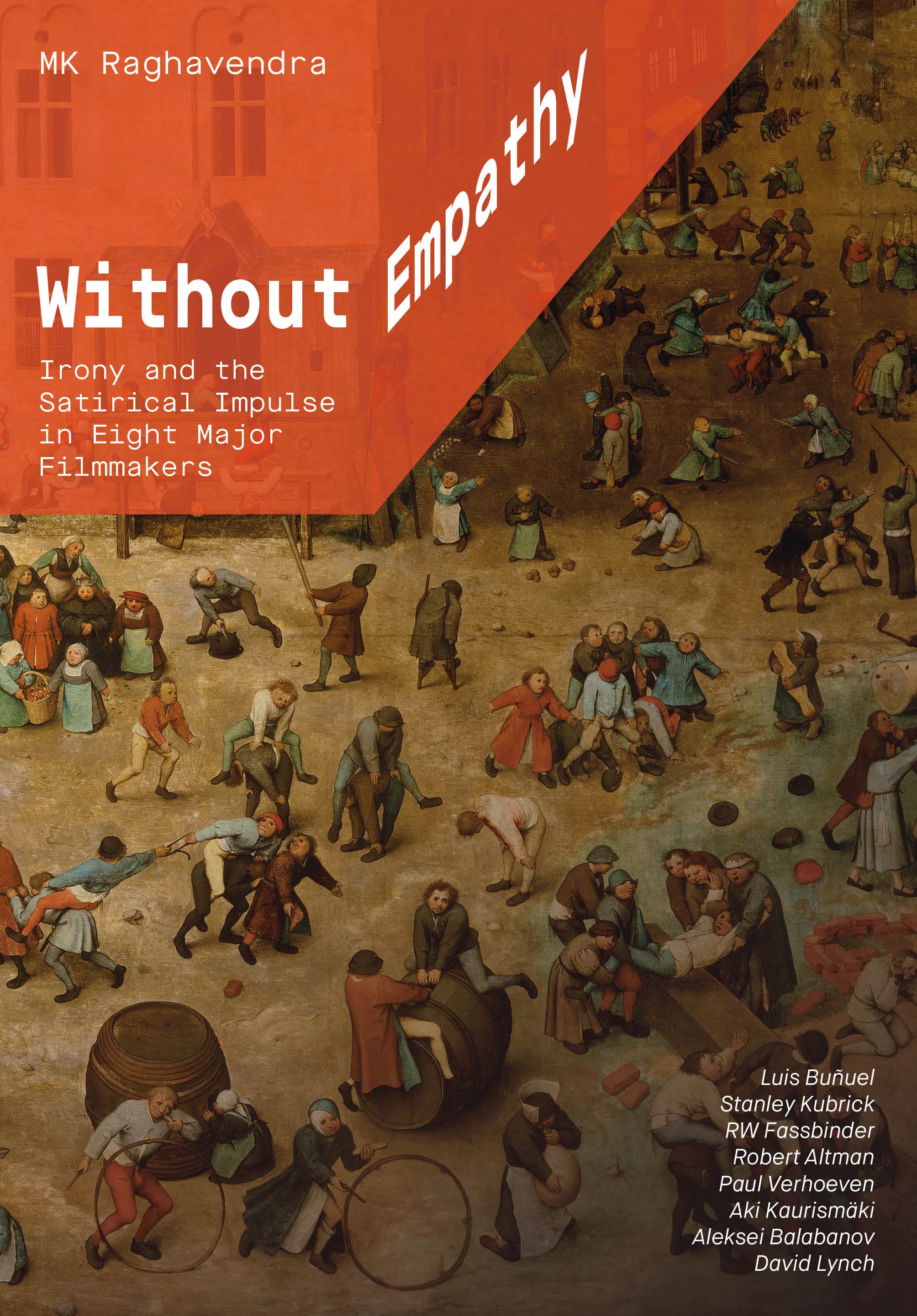
Intellect Books / University of Chicago Press
“Censorship is the mother of all metaphor”
Jorge Luis Borges
It’s always heartening to encounter other lovers of cinematic art who resonate with one’s own passions for moving pictures that speak in a kind of secret language that we alone can fully understand. Even if that we is a large multitude of sorts, the pleasures we share in the brilliant darkness of movie theatres still seems to situate us in a private world unfolding before our mesmerized eyes. Between the flickering screen and our witnessing selves there is a shared bond which speaks to us in a dialect constructed from images that sometimes tell a story somewhat different from the linear narrative of the script. Certain filmmakers also excel at using an ironic aesthetic to effectively satirize or even subvert our own expectations.
Without Empathy: Irony and the Satirical Impulse in Eight Major Filmmakers, a captivating new book by India-based film and literary scholar MK Raghavendra, is a cogent exploration of this paradoxical domain in which irony and satire are impulses often used creatively to circumvent even the conventions of the industry itself, ostensibly an entertainment system, within which some directors somehow manage to achieve a popular acclaim and critical success that are themselves frequently at odds with the challenging source material they choose to film.
A handful of them, titans such as Luis Bunuel, Stanley Kubrick, Rainer Fassbinder and David Lynch, manage to invite us into their dream worlds and succeed in innovating altogether new ways of seeing and storytelling. Another creative cluster, artists such as Robert Altman, Paul Verhoeven, Aki Kaurismaki and Alexsei Balabanov, achieve a special stature reserved for cinema craftsmen who specialize in seemingly biting the hand that feeds them. It’s a paradox perhaps that some audiences, those who share in the often caustic bond these storytellers are sharing in their work, willingly put forward their hands to be gently gnawed on aesthetically. Such is the community of independent cine-artists which has inspired Raghavendra to isolate and identify the impulses behind their films as exemplars of imaging irony and satire.
The carefully curated grouping of directors the author examines in his book also automatically makes one pine for a film program that features their communal interests via a selection of their most emblematic works. Perhaps such a program will follow, since the sequencing of certain films by these directors would accumulate an impressive conceptual wave of awesome proportions. Some of the double features could be illuminating indeed. The first such combos that spring immediately to mind for instance (or at least to my celluloid saturated mind anyway) could be a pairing of Bunuel’s Phantom of Liberty, 1974 with Altman’s The Player, 1992, or Fassbinder’s Veronika Voss, 1982 with Lynch’s Inland Empire, 2006. You can proceed with that curatorial parlor game at your leisure of course, while I hasten back to the thesis of this fascinating book.
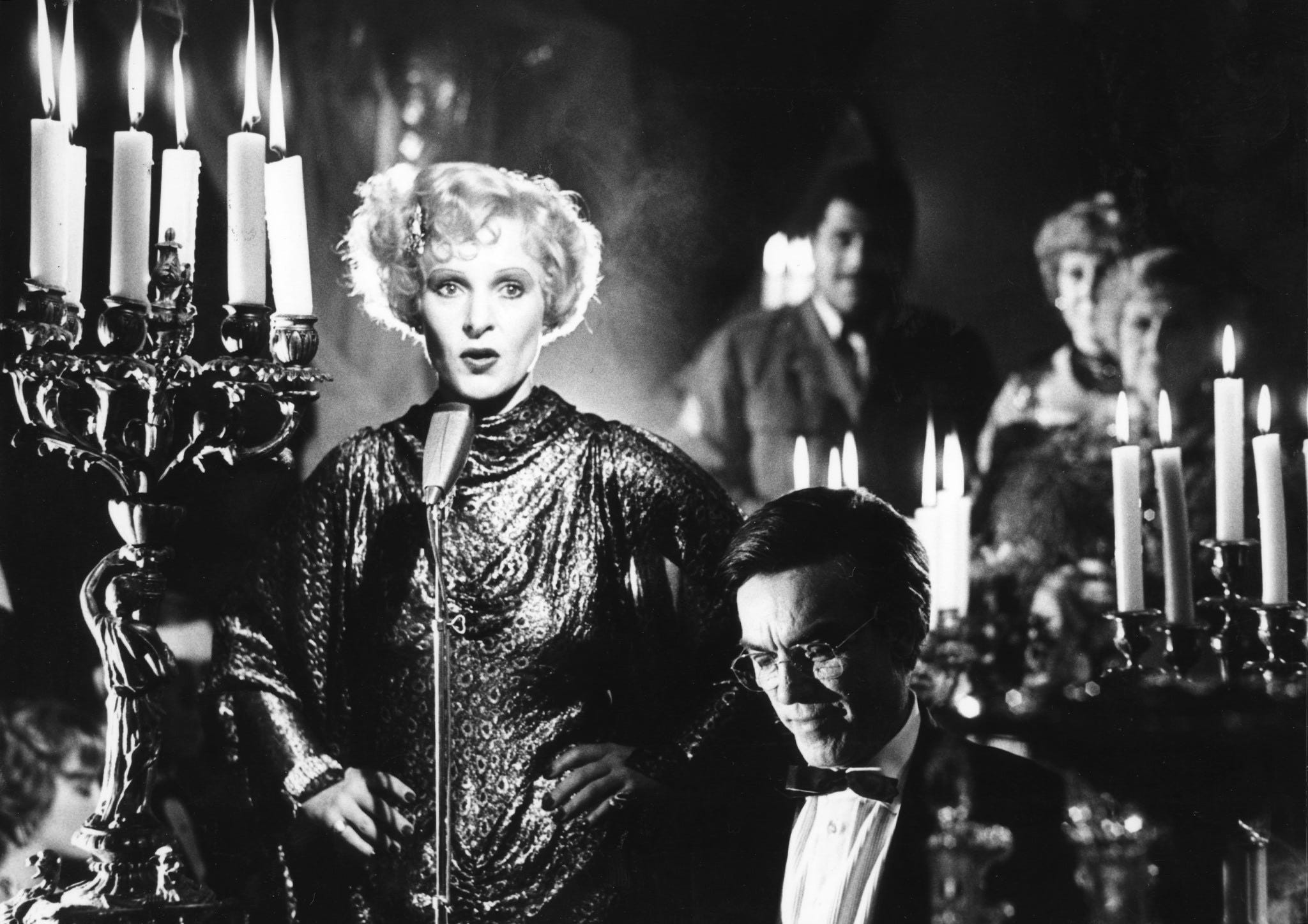
Veronika Voss / Rainer Fassbinder 1982
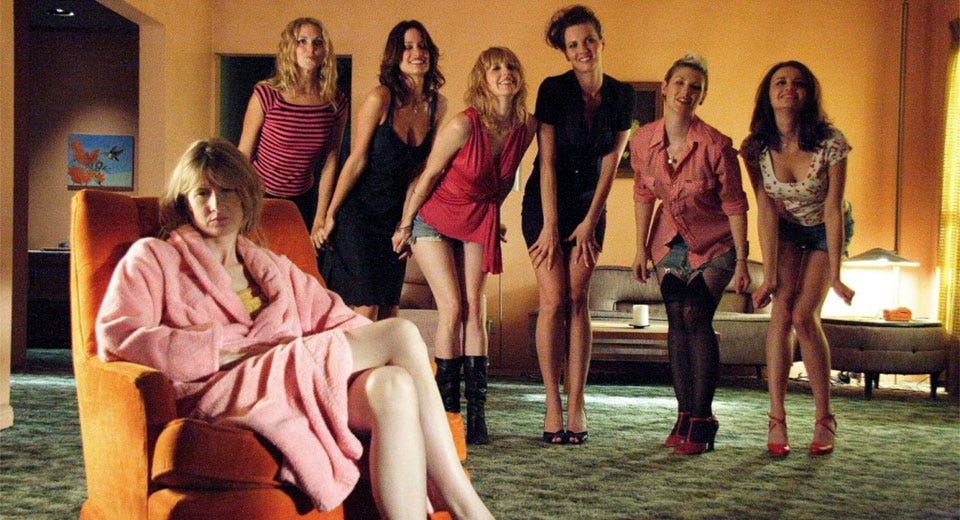
Inland Empire / David Lynch 2006
Raghavendra is a notable film scholar who has penned eleven books on film and politics, among them the highly regarded Seduced by the Familiar, 2008, as well as a book on legendary Indian director Satyajit Ray, 2021, and he also serves as Founder/Editor of Phalanx, a journal of debate in the humanities. He gets right down to business in his Introduction going on the record as to what his potentially ambiguous subject and theme here is, and oddly enough one of the key elements he appreciates in the eight filmmakers whose works he profiles is that very ambiguity itself. Also, obscurity of meaning, intention and purpose in their often obliquely angled works is precisely what he wants to showcase in this new tome:
“This book is focused on irony and the satirical impulse as expressed in cinema through its appearance in the work of filmmakers of importance. By irony what is meant is neither situational irony nor dramatic irony but only verbal irony or its cinematic equivalent: the treatment implying that something is not meant to be taken literally. Irony is a useful strategy to use when the theme dictates a certain emotional response (Kubrick’s Paths of Glory, 1957 or Altman’s M.A.S.H., 1970). Often these filmmakers say something with a straight face which they want us not to accept, all of them also often say something they do not actually mean and expect people to understand not only what they actually do mean but also their attitude towards it.”
The author astutely unearths in great depth and detail both what such cine-artists really mean, and what we really comprehend, by consistently using irony in films that are often too ambiguous to be termed ‘satire’. Both irony and satire, especially for instance in Altman and Kubrick, are regularly employed to say something contrary to the truth in order for the truth to be exposed to a general public for the purpose of awareness and social change. The book commences with a detailed but efficiently delivered series of sections on the satirical impulse, both in history and in contemporary culture.
Without dwelling at length on what he terms the historically satirical affiliates, he deftly touches lightly upon Juvenalian satire, Horatian satire, burlesque and parody (Dr. Strangelove, 1964, being probably the most brilliantly utilized example) as well as the overtly carnivalesque and hyper-sarcasm modes (to some extent Lynch’s whole body of work is an exemplar of almost all of the above ingredients, including film noir tragedy and surreal comedy, often at the same time). He then assists those of us who were slightly puzzled, at first, by his main title Without Empathy:
“The key tendency in the works described is to distance the reader/spectator from the action. But one of the characteristics of arthouse cinema today is arguably its tendency to elicit empathetic responses from its audience, to identify with the protagonists to the greatest extent possible. Empathy however is not always a laudable emotion to enlist since it promotes passive viewing. The issue here is what emotions should be appealed to, and many artists have proceeded with the belief that distance is desirable since it would facilitate reflection. But irony. satire and their affiliates, as may be evident, stand at the other end in the emotions they try to enlist, away from empathy.” This suggest an active involvement in both the action presented and the subtext lurking beneath it, as viewers are free to interpret what they witness and feel as they see it.
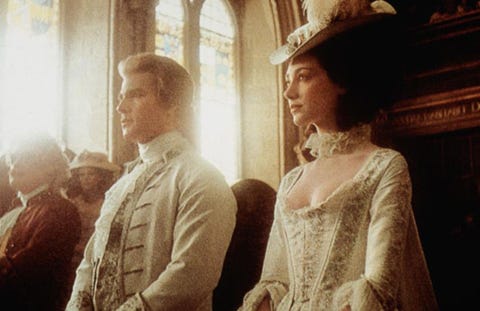
Barry Lyndon / Stanley Kubrick 1975
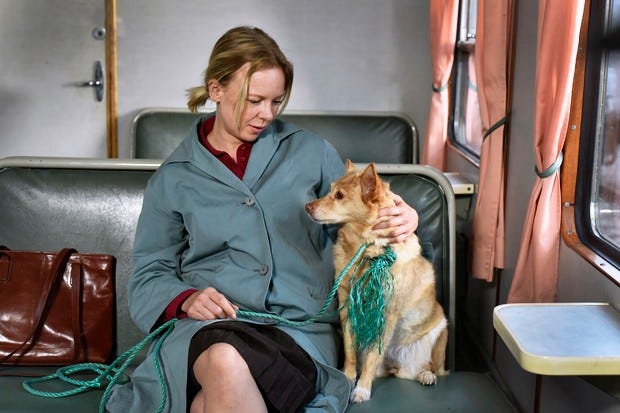
Fallen Leaves / Kaurismaki 2023
It helps to remember of course that this critic/historian is always discussing ‘arthouse cinema’, apart from some occasions where differentiating them from popular entertainment such as James Bond movies further elaborates whatever point he is making at the moment. So readers with some familiarity with the kind of cine-artist whose works are essentially paintings in film, the kind that celebrate a certain stillness, motionless dwelling, slowness and highly stylized visual detailing, will naturally be the ones who most comfortably traverse his prose. But those other readers who are curious about the phenomenon of cinema as visual art, and are willing to explore the subject with some degree of patience, will also benefit greatly from his very accessible narrative.
“Some of those I have selected—especially Bunuel, Fassbinder and Kubrick---have been widely written about but their work is too complex for everything possible to have been exhausted, and so still one makes discoveries. The eight individual filmmakers being studied in this book are not alike and there could even be disagreement that Fassbinder and Lynch are satirical. But the fact is that all the filmmakers appear to have the kind of artistic sensibility that can be termed sardonic, producing at some point or other work with a satirical bite. Another factor bringing the filmmakers together is that where the satire is usually transparent, these filmmakers have made films that are puzzling, thus inviting interpretation, but also resisting it.”
Such cine-artists are, of course, right up my alley, but anyone with an interest in films as a sequence of still images magically moving in time and space at the service of telling a story, even if it might be a perplexing or distressing one, will find these films richly rewarding, and such an aesthetic alley often offers and delivers a most elegantly refined pleasure. And these are also the ideal readers of this book: readers who don’t mind scratching their heads a bit in a state of something resembling bewilderment perhaps, but also simultaneously in a state of beautiful wonderment. That state of mind is summed up quite succinctly in the author’s ongoing aesthetic assessments. He excels wherever he situates his and our viewing experience in the context of emotions which are somewhat controlled, or even occasionally manipulated, by the film’s director.
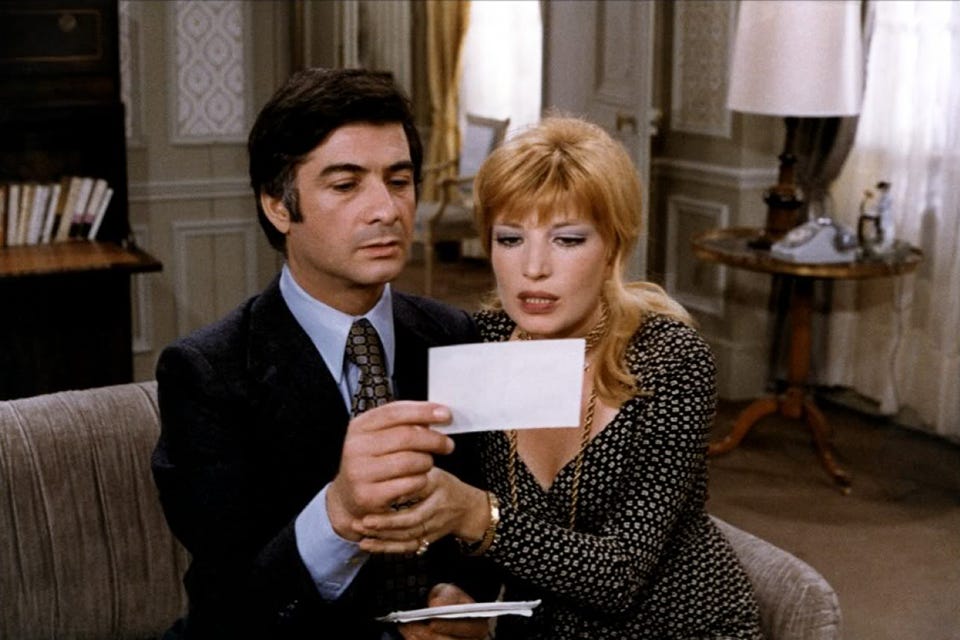
Phantom of Liberty/ Luis Bunuel 1974

The Player / Robert Altman, 2006
As to the book’s subjects and themes. Luis Bunuel, 1900- 1983: Spanish/Mexican filmmaker widely considered one of the most influential in history who, though popularly associated with the Surrealist art movement moved far afield of its aesthetics, while still maintaining a provocateur stance in his innovative projects. His Diary of a Chambermaid, 1964 and Belle de Jour, 1967 are prime examples of his inventive combination of heightened sexuality and social commentary, often cloaked in a neo-noirish tone which met with great critical success. Always a permanently acquired taste for many, once savored, his cinematic flavour was never forgotten.
Rainer Fassbinder, 1945-1982: A German dramatist and actor in his own right, Fassbinder became something of a lightning rod for what was once called new cinema. When you only live for 37 years, you have to move fast to accomplish what you want to do, whether or not anyone else wants to help you in your mission. Titanic talents, given the obvious scale and volume of his accomplishments, he created over 44 films that swiftly erased conventional genre boundaries, all while frequently blending experimental Euro-vibe style with classic Hollywood melodrama most often associated with his beloved Douglas Sirk. The Bitter Tears of Petra von Kant, 1972, and Effi Briest, 1974, and Berlin Alexanderplatz, 1980, all deal with one of his favourite motifs: personal loneliness and the consequences of unrequited or betrayed love.
Robert Altman, 1925-2006: Highly acclaimed American member of the ‘New’ Hollywood era, his legacy has been an enduring blend of satire and subversion, overlapping complex dialogue and regularly enlisted ensemble casts. His McCabe and Mrs. Miller, 1971 and The Long Goodbye, 1973, and The Player, 1992, all did so well what he is renowned for, reinventing classic genres, in these cases the western and film noir, enlivening the storytelling with contemporary twists and a consistent Altmanesque irony. He is among several filmmakers who have also ventured into the television domain, usually with refreshingly unconventional results owing to his disregard for the accepted limits of commercial broadcast entertainment.
Aki Kaurismaki, 1957-68 years: Finnish screenwriter and director perhaps best known for elliptical movies such as Leningrad Cowboys Go America, 1989, Drifting Clouds, 1996, and Fallen Leaves, 2023. After working a number of fields, many of which inform his cinematic content, he was also active as a critic, an activity which also (like Truffaut and Godard), hugely influenced the style of film he would eventually create. That style has been lauded as distinctive and idiosyncratic (something shared by all the artists in Raghavendra’s book) as well as quiet and minimalistic in tone. A classic auteur, since he writes, directs, produces and usually edits all his works, they often contain elements of his own character, which has been described as droll and deadpan.
David Lynch, 1946-2025: Often characterized as possibly the most quirky and dream-like filmmaker to ever somehow reach a mass mainstream audience, he began his professional life as a painter, and it shows in his works. His debut in 1977 with Eraserhead is still raising eyebrows owing to its overt surrealist and experimental aspects, while Blue Velvet, 1986 and The Elephant Man, 1980, have achieved a lofty position in the canon of contemporary cinema. One of the most indelible marks in his lengthy career came about as a result of collaborating with Mark Frost on the bent neo-noir postmodern masterpiece for television, Twin Peaks, 1990. That self-reflexive and distressing serial masterpiece is credited with ushering in a whole new genre of broadcast entertainment, one without a suitable name.
Alexsei Balabanov, 1959-2013: A Russian filmmaker of distinction and a member of the European Film Academy, began by making what most identified as ‘arthouse’ films but soon, seemingly by accident, achieved a mainstream popularity that surprised even him. Happy Days, 1991, was based on Irish playwright Samuel Beckett’s works, and The Castle, 1994, based on the existential novel by Franz Kafka, launched his acclaim as a serious artist. But it was his breakout hits Brother, 1997, Brother 2, 2000, and Morphia, 2008, that not only established him as a gifted filmmaker but also as a major influencer in global visual culture. Alas, he was unfortunately plagued by a depression caused by guilt over the loss of several close friends, descended into a downward spiral of alcoholism and died of a heart attack at age 54, depriving the film world of a uniquely insightful talent with some salient similarities to Fassbinder. Balabanov has the paradoxical distinction of being considered both a nationalist and also a maker of ‘negative things’.
Paul Verhoeven, 1938-87 years. A Dutch filmmaker equally active in America, the Netherlands and France, who crosses borders in more ways than one. At first glance I was surprised to see his name as seemingly an odd man out role amongst the directors being examined by this author, until I went further into the logic he used to position him in this particular flock. I had assumed he was a maker of blockbuster fables with great popular following, which is true, but he is also a stealthy satirist known for utilizing the stalwart traits of action romance movies, graphic violence and sexual content, in a boldly self-reflexive and ironic manner. Soldier of Orange, 1977, and The Fourth Man, 1983, were still in his Euro-arthouse vibe, but they were followed in rapid succession by the kind of Hollywoodesque shiny content for which he became famous, RoboCop, 1987, Total Recall, 1990, Starship Troopers, 1997, Basic Instinct, 1992 and Showgirls, 1995. It takes a special kind of critical eye to detect that they too subvert expectations via the tools of irony and satire, however cleverly concealed in their extravagant, even gaudy, entertainment modes.
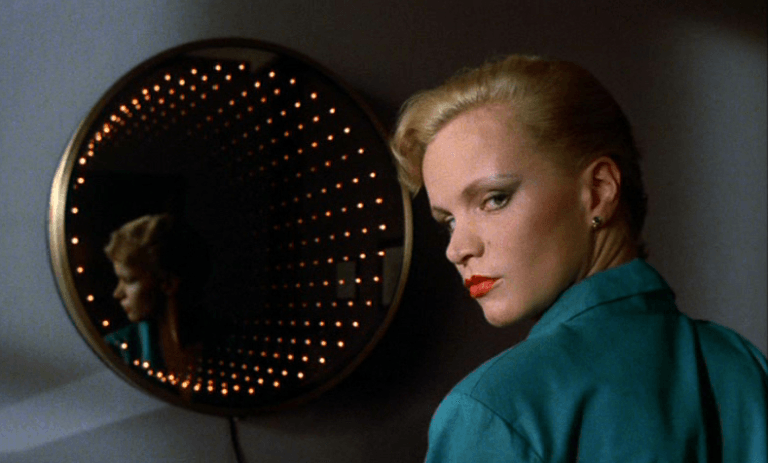
The Fourth Man / Paul Verhoeven, 1983
This is a very fine study indeed of the subconscious mind of contemporary cinema, via an excursion through eight of its most notable artists. Though I’m still coming to terms with his notion that most films adhere to attempts to create empathy, which requires a distance within which the audience can reflect, whereas the films he’s exploring eschew or avoid empathy by manufacturing an immediacy inherent to irony and satire, I find the manner in which he expresses his arguments to be kind of enthralling, as are the films whose virtues he extols.
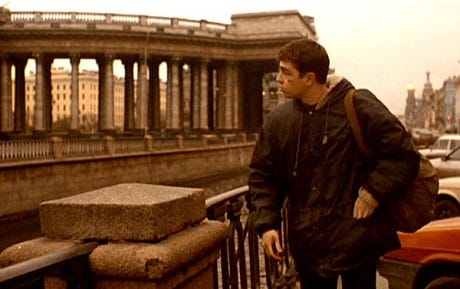
Brother / Aleksei Balabanov, 1997
At the outset when I mentioned a personal resonance, I was referring to the stylistic overlaps in a film program I once curated for Cinemathque which featured several close aesthetic cousins of the works the author examines: Fitzcarraldo by Werner Herzog, 1982; The Mirror, by Andrei Tarkovsky, 1975; Landscape in the Mist, by Theo Angelopoulos, 1988; Woman in the Dunes, Hiroshi Teshigahara, 1964; Last Year at Marienbad, by Alain Resnais, 1961; Wings of Desire, by Wim Wenders, 1987; Blue Velvet, by David Lynch, 1977; and Alphaville, by Jean-Luc Godard, 1965.
I reference these eight now solely because they occupy an intimate space in what I’ve called exactly the same artistic alley as the cine-artists featured by Raghavendra, one focused on the hyper-visual and often ironic suspension of disbelief so crucial to all great movies. In addition, it is also my intention to pay tribute to his fine book by curating a Cinematheque film program featuring double features drawn from the eight directors he has explored. Hopefully this would also result in having him available to visit us for a lecture with a Q and A session.
Thanks Donald
As usual, you write of the things that are close to my heart, mind and soul. (Without empathy of course ha ha) but lots of enthusiasm and knowledge of these particular filmmakers. I wasn’t, however familiar with the Author of “Without Empathy.” Another reason to thank you again.