
Iconophilia:
Perpetual Morphosis

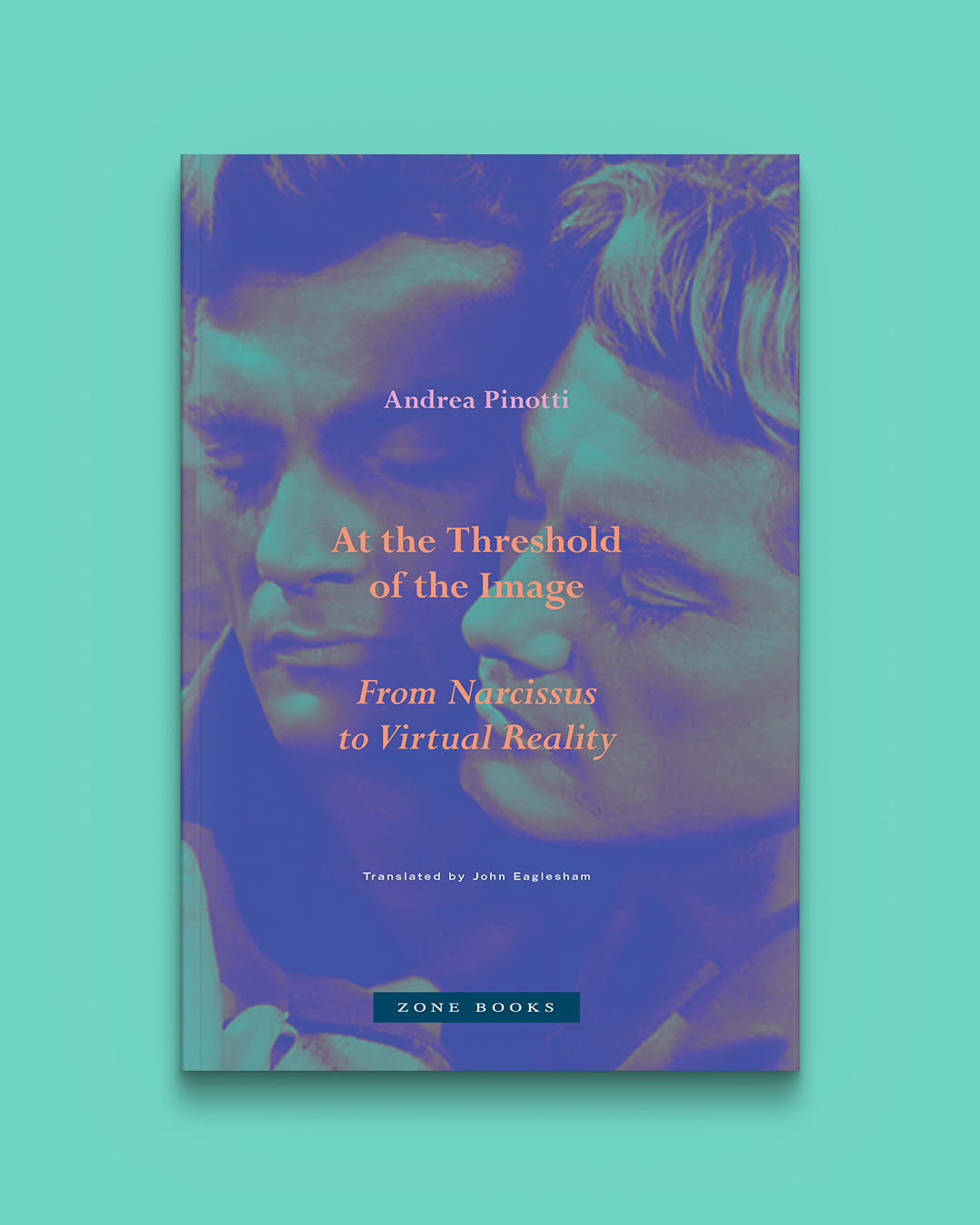
Zone Books / Princeton University Press
“Unframedness. Presentness. Immediateness. It is under these three titles — intimately related — that we now experience the image by means of those devices that constitute image-making strategies: virtual immersive environments.”
Andrea Pinotti
Consider this book as what rightly amounts to a veritable biography of The Image: its history, both overt and covert in all our lives, and as both a secret story communally shared and also an unimaginable one taunting us to keep going towards what used to be called the future. Extending from a time long before any recorded history even existed, right through to a time after which history, at least as we once regarded it, perhaps owing to the sheer acceleration and amplification of those lives, might even have ceased to exist at all. The most succinct and accurate synopsis of this breathtakingly insightful book by Andrea Pinotti, At the Threshold of the Image: From Narcissus to Virtual Reality, is equally breathless: this is an exploration of the impact of immersive experiences on visual practices from cave painting to virtual reality.
In order to do so, Andrea Pinotti, a Professor of Aesthetics at the University of Milan who is also the author of Empathy: A History of an Idea from Plato to the Posthuman, takes us all the way back to the cave. There we find the basic allegory within which we have persisted to dwell, despite the radical changes and enhancements afforded us by our rapidly advances in technology while we were being colonized by its phantoms: the shadows reflected and refracted on the cave’s walls. Some were placed there accidentally by the flickering campfires of our antecedents and mistaken for real, others we placed there ourselves by painting animal images on the cavern’s roof and imagined that they could be real if we wanted them to be.
One of the many pleasures of this book is the manner in which the author examines the consequences of the primal desire of human beings to enter an image, not just to observe or even be absorbed by its potential beauty or powers but to actually erase the boundary between ourselves and the image we so admire that we want to occupy it totally, to live in it. Cinema provides something of the germ of this desire, and in a majestic manner, but still people want more, and Pinotti studies what that more might consist of and how it propels up forward into a future where something like the concept of the popular film The Matrix might no longer be fictional. The main crux of his proposition here is that every culture has attempted to realize this desire by whatever technical means were available to it at the time.
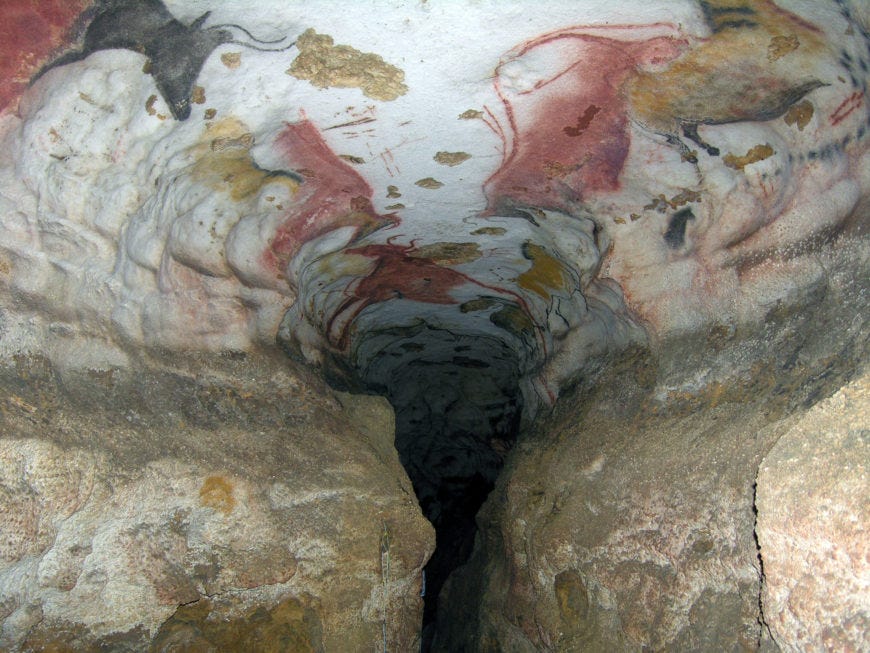
Lascaux, 20,000 BCE.
Along the way, by virtue of his expert guidance across a territory customarily traversed in the dreams (or the nightmares) concocted by poets, storytellers, artists and musicians, Pinotti demonstrates with ample skill how we eventually manufactured our own caves high above ground, within which we could even wear mobile headsets in order to further fuel the fires within. But it all commences at the water’s edge. After emerging from the cave, where we were entranced by dark shadows on dark walls twenty millennia ago, Pinotti commences his trek through time outside in the blazing sunlight of Greek mythology, a merely two millennia past, where we first encounter the enigmatic emblem of our passion for self-indentified images: the watery surface that hypnotized Narcissus into an endless loop of doomed personal adoration.
Narcissus was a handsome youth from Thespiae who was told by the blind seer Tiresias that he would lead a long life as long as he did not ‘know himself’, a prophecy which was ironically opposite to the philosophical maxim inscribed on the Temple of Apollo in the ancient precinct of Delphi: know thyself. It may well have benefited from a subtitle: but don’t get carried away.
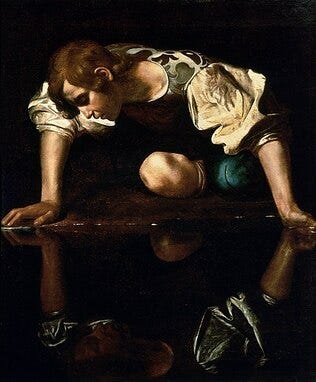
Narcissus, by Caravaggio, 1597
His beauty was of such magnitude that he fell in love with his own reflection in a pond, eventually drowning and being transformed into the flower that bears his name. From this simple admonition against self-absorption Pinotti launches the trajectory of his fascinating conjectures, first pondering how naïve we need to be not to be able to differentiate between ourselves and a mere reflection of that self. Pinotti artfully differentiates the two Narcissues: the naïve and the self-aware.
“A story that has been capable of deeply molding the imagination of the West for many centuries, a myth in which at stake is not only the origin of the image, but also the transgression of the boundaries between reality and representation. Returning again today to this myth may allow us to unleash its unexpected potentialities: regarding not so much the origins of painting but its extreme outcomes, which we experience today in the form of immersive virtual environments, in the form that is, of environments in which the transgression of the boundaries between reality and representation is configured, as we shall see, as a peculiar form of narcissism.”
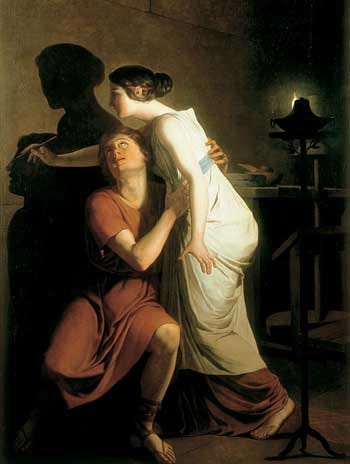
Invention of Drawing, Joseph Suvee, 1793
From cave walls to obscura shadow boxes, to photographs and films, to digital domains leading right up to VR equipment inaugurating a 360 degree immersive environment (albeit a simulated one) in which the frame that used to contain it separately from the real world vanishes entirely. This new, or latest, technology of course renders the physical medium which used to house the image, and is now either transparent, porous, or both. But Pinotti also hastens to draw our attention to at least one of several dangers inherent in these new image delivery systems: once the borderline between the real world and the domain I refer to as the Iconosphere disappears, not only can we enter fully into the image, but the now penetrated image also comes pouring into our actual world and live amongst us. As Pinotti explores both the desire to vanish into images and the existential dread of images subsuming our own reality, he brilliantly touches lightly upon the terrains of myth, drawing, painting, sculpture, architecture, panoramas, phantasmagorias, and also the original primitive creative origins of VR itself, 3-D cinema.

Louis Ducis, Origins of Painting, 1808.
Stranded on the desert island of the self, the forward march of images of mythical otherness continues apace, unabated even as it arrives in our drastically solipsistic postmodern world. But, as Pinotti stipulates: “If, as has been observed, every age deserves its own Narcissus, it would be impossible to do justice here to the history of its iconography, which is indeed characterized by the prevalence of the self-aware type, but will never definitively erase the polarity between naivety and image consciousness. The myth of Narcissus contemplating his reflected image at the spring is inexorably linked to the theme of the mirror and its complex symbolism. The same with immersive virtual environments (VR): how are they transforming our experience of images?”
His utterly earnest query is simple and yet profound, as he identifies the ambiguous profile of immersiveness (in what I have often referred to as the Neo-Baroque) as a true two-faced Janus: the loss of the boundaries of the actual self in the indistinguishable interzone between reality and a fused image-representation. In other words, the complete collapse of a border between what is perceived and what is imagined. Until the woeful time though, we can still reveal in what Musil’s enigmatic character of Ulrich, in his appropriately titled The Man Without Qualities, referred to as ‘borderline experiences.’ And today they abound more than ever, as we occupy a zone almost exclusiveness devoted to porous borderlines.
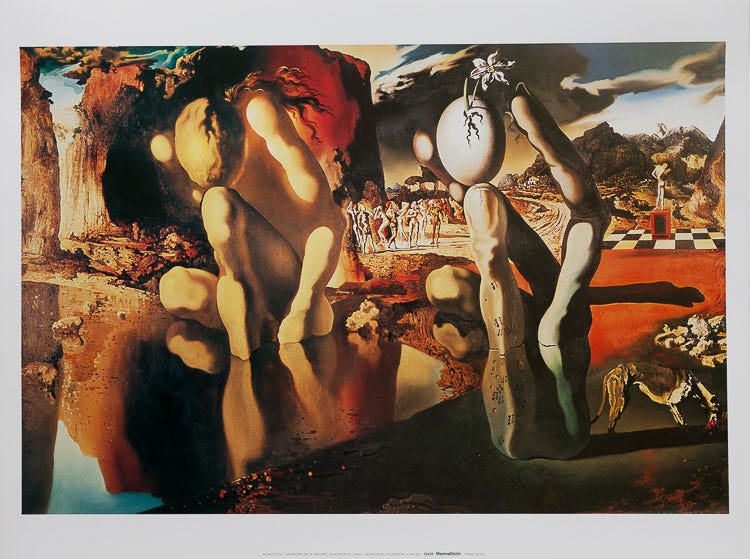
Salvador Dali, Metamorphosis of Narcissus, 1937.
Such a liminal perceptual zone, it occurs to me, is precisely what we have already witnessed in the cinematic visual art of David Lynch, and especially in his hyper-personalized at home experience of his one of a kind subversive narrative television series Twin Peaks in 1990 with his collaborator Mark Frost. Lynch and Frost became the new corporate brand for entertainment as immersive as it could possibly be while still situated in a two-dimensional medium. One shudders to think what it might have felt like in a VR tech delivery system.
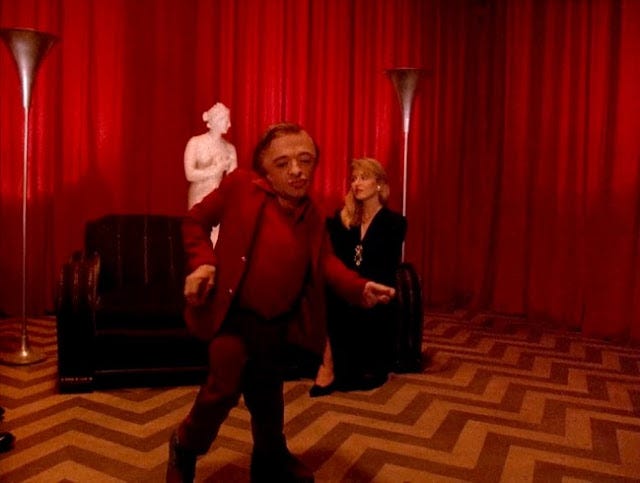
The waking dream-world of hyper reverie that was Twin Peaks.
My favourite chapter in Threshold is number six, “In/Out”, where Pinotti gets down to the brass tax of his core thesis: “The journey through immersive optical devices in the nineteenth century has led us to the advent of the cinema and the various strategies for modulating the gaze that moving image technology can offer in order to promote an osmosis between reality and representation.” And what a long strange trip it’s been. He then puts forward his analysis of what he terms exemplary cases in the history of cinema that have focused in the dual “in/out” moment of entering (immersion) and exiting (emersion) the image. Identifying them as strategies of course also implies that they will never end, at least not until the Wachowski fiction of The Matrix has come to pass in all its sinister glory. For me, some of the most profound media works exploring the erasure of inside and outside the image have been not in the entertainment industry per se but rather in the customarily more rarefied atmospheres of the fine art world. The best examples that come to mind are touched upon by the author with the gravity they truly deserve as what the he feels are ‘exemplary cases’.
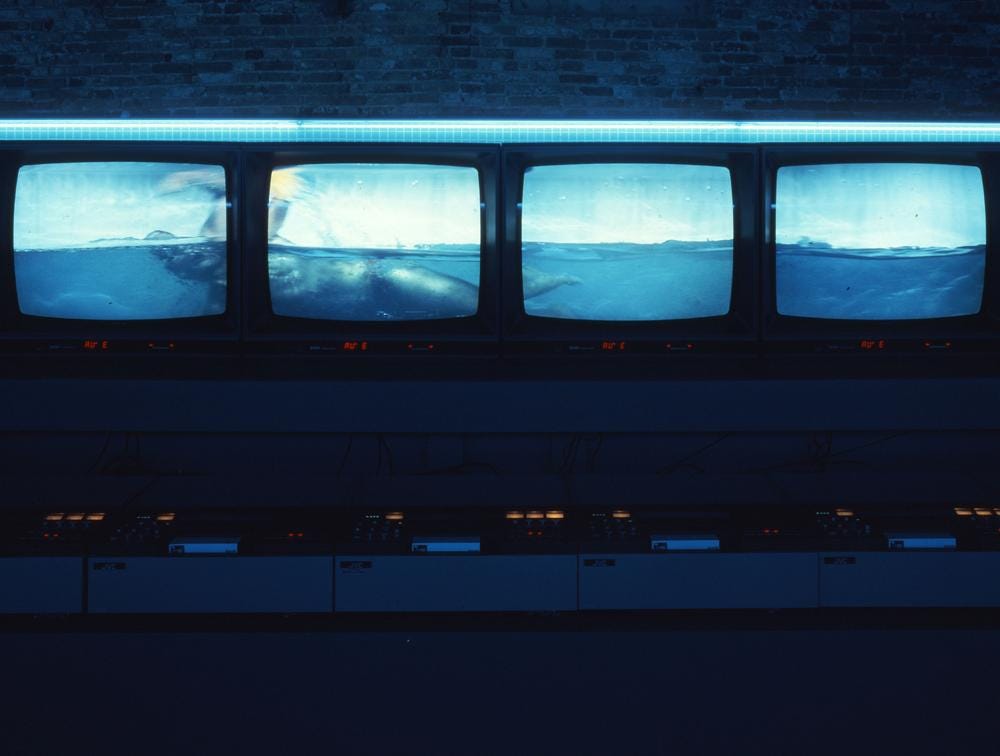
The Swimmer, 1984 by Studio Azzunno.
“The Swimmer” is part of an installation by an artists workshop in Milan featuring a 1984 video environment in which a swimmer swims his laps nonstop through a sequence of synchronized screens, while appearing to break through the frames of twelve side by side monitors. An additional monitor showing moving image of a clock in an overall blue-lit space saturating the ambience with the sensation of an underwater world is supplemented by the sounds of water and music. The room containing the installation also itself designed to simulate an indoor swimming pool.
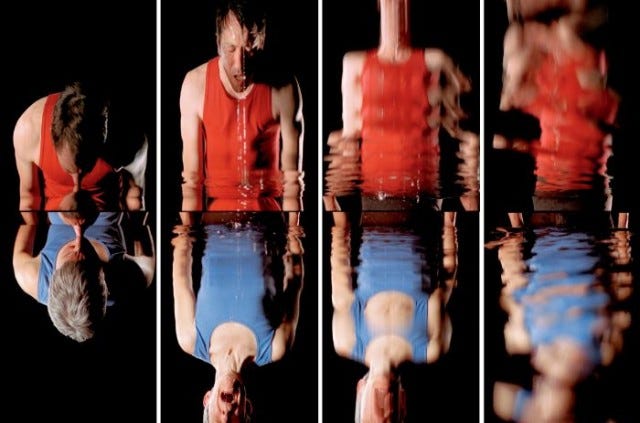
Surrender, 2001, by Bill Viola
“Surrender / Double Negative”, 2001, shown in Gloucestershire by American video artist Bill Viola emphasizes that ‘transcendence and the desire for human connection are integral to our condition’. It consists of a diptych of double plasma split screen displays presenting a woman and man in what appear to be moments of anguish which could just as easily be ecstasy. Each is a reflection of the other, submerging themselves in water and then re-emerging with a powerful gasp of breath, with a dominant theme being untouchable desire, and potentially also unreachable aims.
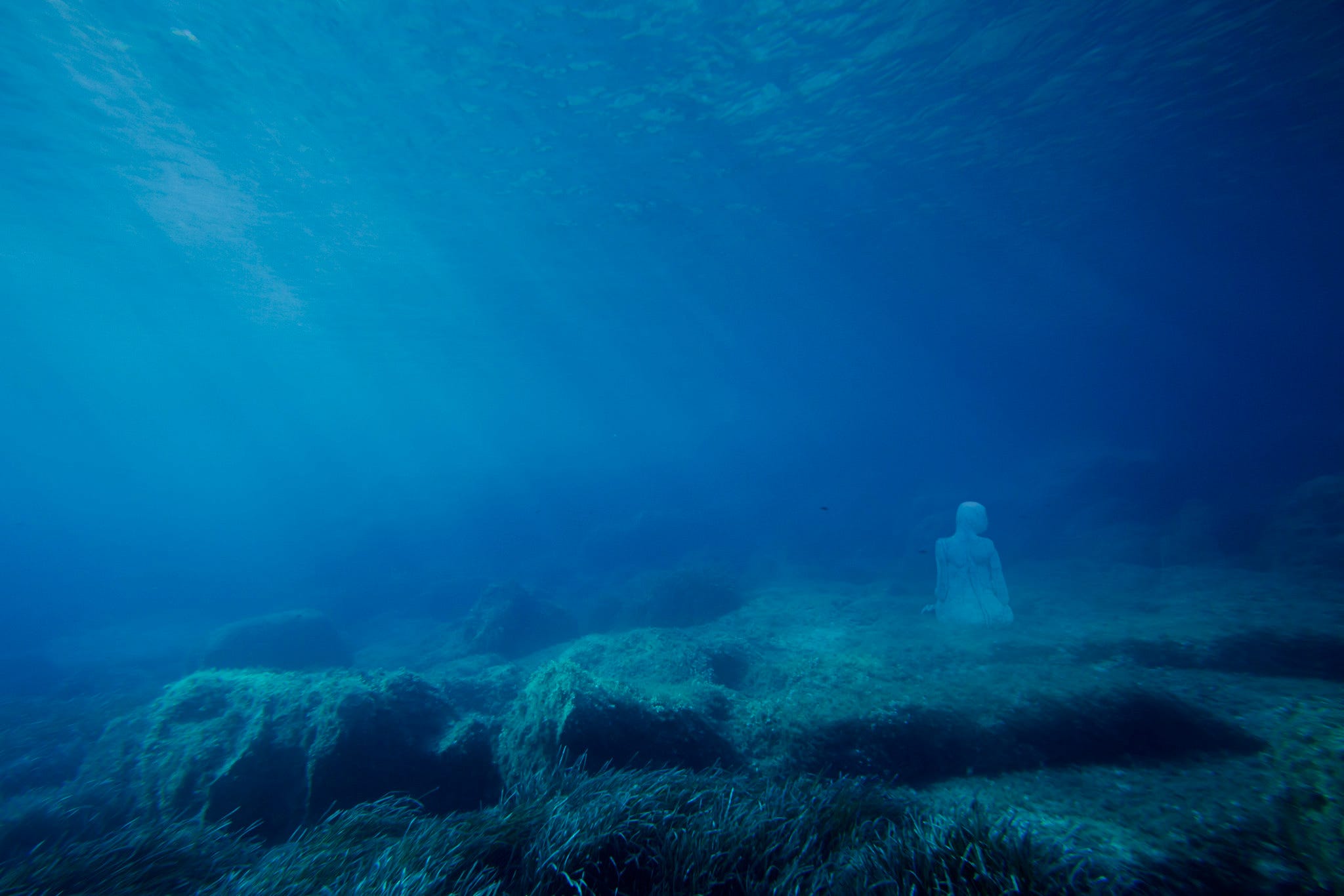
Apnea, 2016 by Vanessa V.
“Apnea”, 2016, by Vanessa V., is an interactive and immersive open documentary about migrants at sea with a poetic focus on what she called ‘the eternity of absence’. Realized in Lampedusa, while exploring the emotional dimension of those who venture outward toward sanctuary, she also proposes what she calls ‘an inner itinerary that we can all recognize: a cartography of feelings and fears mapped using interactive immersive technologies and an exhibition of objects salvaged from the sea’. In addition to sharing the sensation of being lost/found on the water in search of deliverance, the audience itself goes on a VR voyage which plunges it into a shared experience of sensory displacement.
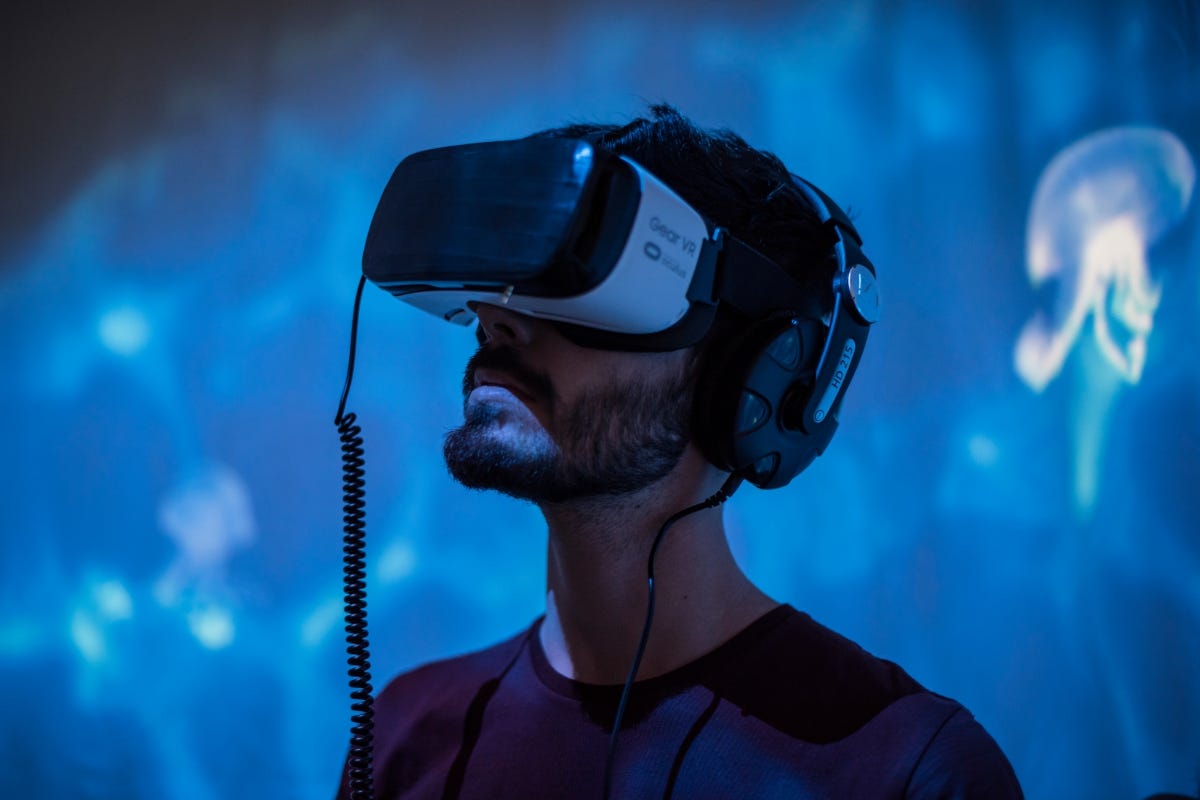
In his book’s epilogue, Pinotti sums up his aesthetic enterprise as a philosopher of images perfectly while referencing the notion of binding/unbinding as constitutive acts of human beings, calling them the bordering creature who has no border. He stipulates that the blurring of image and reality is potentially averted by the traditional framing device (something which I, and he, and a conceptual mentor he identifies as the ‘philosopher of separation”, Georg Simmel, all believe in) largely because that connecting tissue of the frame holds the two operations of image and reality in a bond of intimate dialectical embrace. “Threshold is the name of this embrace. A boundary line between the inside and the outside, the interval between the iconic and the real, it is both a bridge and a door between these two worlds. At the very moment when the image establishes itself as an island, desire is irresistibly triggered to throw a bridge across the moat, to conquer that island. Each visual culture, employing the technologies available in its time and in its own iconic strategies, has interrogated that threshold in its own way.”
And those of us who share this feeling of iconophilia, the deep love of images, will always hope that the threshold sustains its historical prominence, because in that way we can maintain the necessary emotional distance (the zone where Benjamin’s aura erupts) required to continue being conscious of the fact that we are indeed still savoring both the image and its threshold.
Bravo 🦋