

ZONE Books / Princeton University Press
“There are large quantities of human beings, it’s true, but there are even more faces, for each person has several faces.”
Rainer Maria Rilke
“I’ve never stopped questioning the very nature of portraiture because it deals exclusively with appearances. I’ve never believed people are what they look like and I think it’s impossible to really know who or what people actually are.”
Duane Michaels
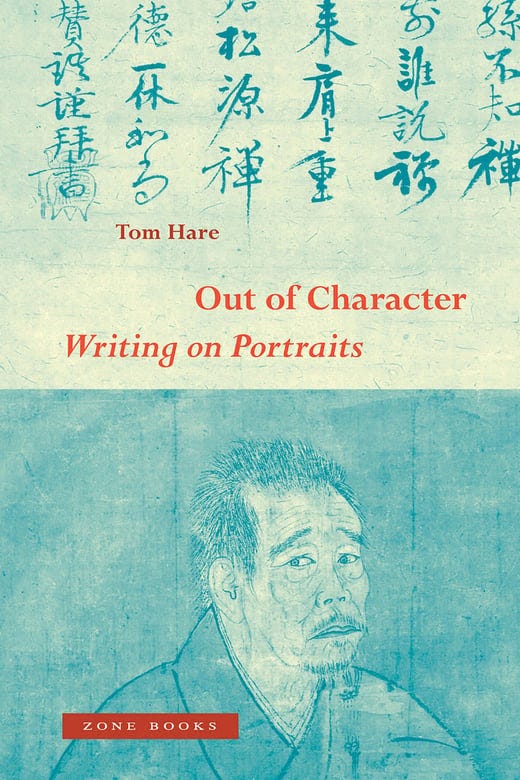
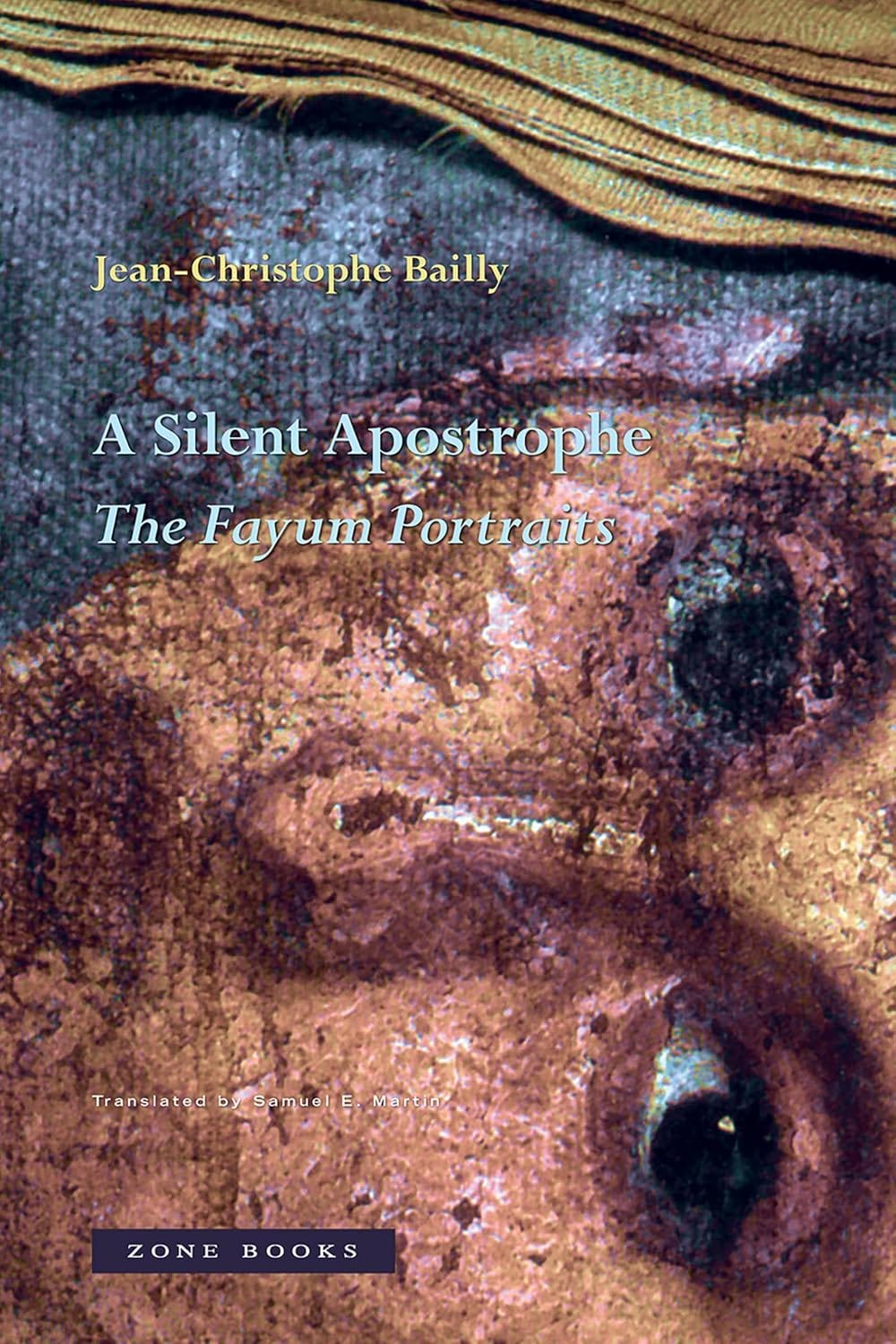
These two remarkable books on the history of facial portrayal, both newly published by Zone Books and distributed by Princeton University Press, each approach this fascinating subject from different angles yet also overlap with each other in ways that might be sheer serendipity but are more likely the result of a deep underlying synchronicity. They each also explore the subject and theme of inscriptions, when words are used to amplify an image and convey a meaning which may or may not already be present in the visual content. Out of Character: Writing on Portraits, by Tom Hare, and A Silent Apostrophe: The Fayum Portraits, by Jean-Christophe Bailly, form an ideal complementary companion set of explorations of portraiture in ways that are both exhaustively researched and scholarly but also have the advantage, like many Zone publications, of being vastly entertaining and informative for a lay public which is curious about the drama of portraits of humans through history. They both share, in many ways, an archaeology of the face across time and place, with every portrait presented being an virtual excavation of that living history. These books are a kind of guided tour of that aesthetic assertiveness, whether the artist makes them idealized perfections or absolute likenesses. Often the wearer of a mask in many cultures is even more revealing than their own real face hidden under its protective seal, and so many portraits somehow feel that the formal subject is wearing a mask. Faces can be explored in every detail of their often subtle domain and this raises interesting questions about altering the face, either by cosmetics, idealistic projection or especially by masks. A mask, as anthropologists tell us, can identify as well as disguise, they have a long tradition in the theatre of many cultures, as cleverly crafted devices for identifying and revealing actors or specific characters. The classical Latin word persona means not only the character played by an actor but also the mask they wear on stage. How much moreso when the mask being worn by the subject of a portrait, whether of humble or noble heritage, is displayed along with the use of words when their shared stage is a painting, scroll or fresco?
Art that stares back at you. How often does that happen? Well, two of the greatest portraits in art history, Da Vinci’s “Mona Lisa” and Warhol’s “Marilyn”, have been staring at us all for five hundred and twenty years and sixty three years respectively, though each in drastically different ways was able to capture the essence of a woman’s face, as well as the potential meanings hidden behind that face. Everybody has one – or even several, according to the poet Rilke. But how often do we actually contemplate not only the handsomeness or beauty of a face, but just what having a face at all means in the first place, and how a face communicates something about us to others long before we even open our mouths? Naturally every culture has differing definitions for what makes an agreeable face stylistically, but all cultures can tell an angry face from a happy one, a serene and comfortable face from one that connotes rage or fear. A face is the most central equipment for expressing feelings and character we have access to, one usually accepted as a means of signifying intelligence and power as well as an unavoidable window into the soul. These two new books show us how the changing face of our face is actually also the human story writ large, not with words but with emotional expressions we all apply by using exactly the same identical ingredients: two eyes, a nose, two ears, a mouth, and the landscape in which they are all situated. As the books cogently illustrate, with captivating illustrations and sculptures from every culture and through every historical epoch, our face is totally central to our cultural identity, which can vary drastically, but also simply to our shared human identity, which never does or can. Both Hare’s book on portraits that either include text as part of their content or have texts written about them in some formal ekphrastic response, and Bailly’s book on the funerary tradition of portraits of the deceased which are actually physically attached to the bodies of the departed, invite us to consider and reconsider the deep meanings of our aesthetic fixation on faces.
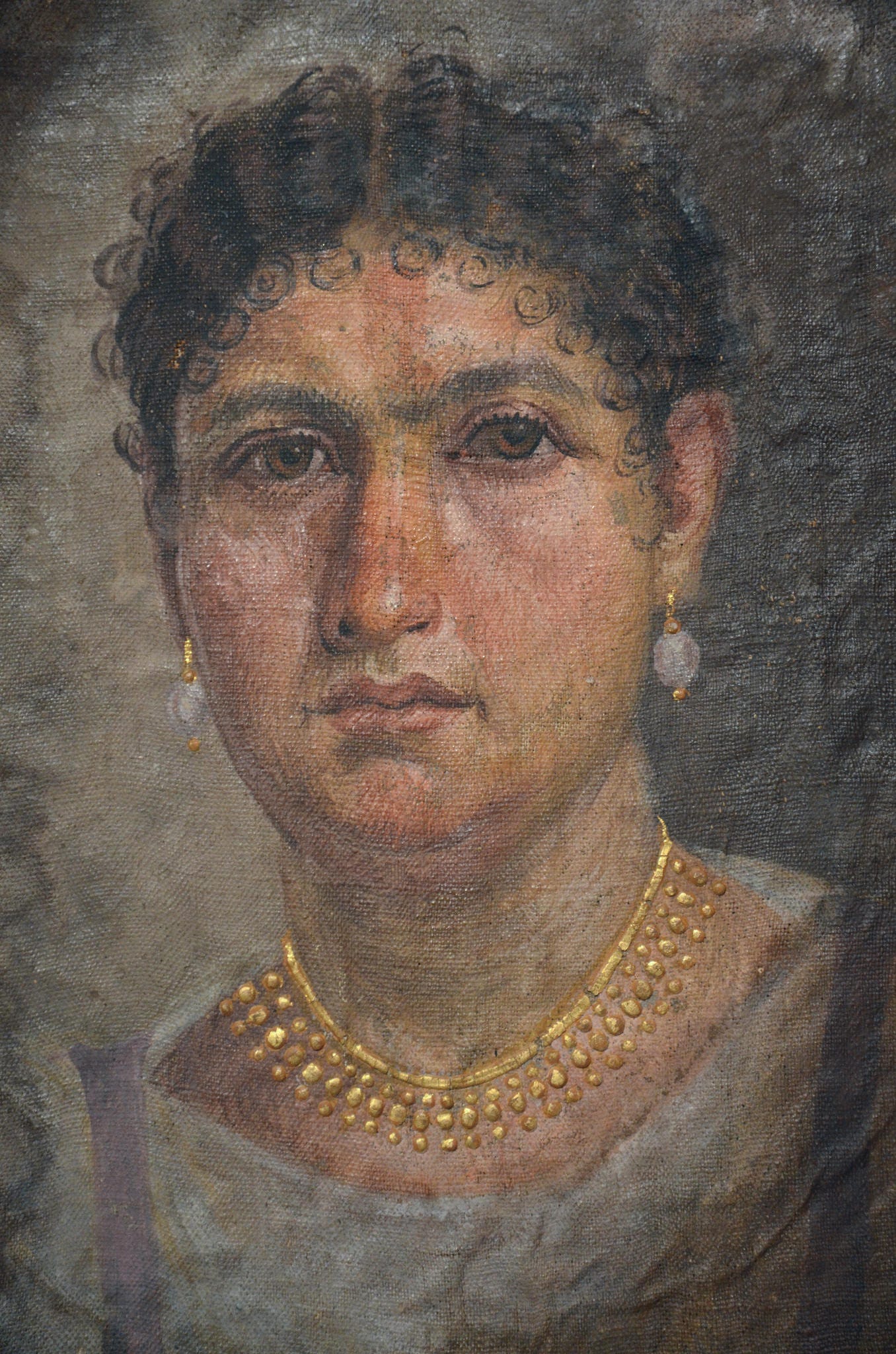
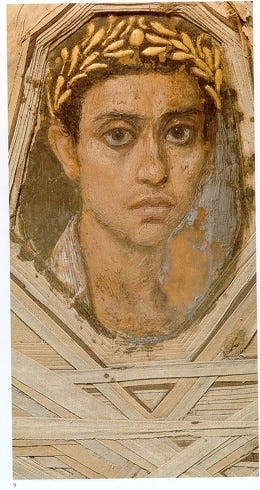
Aline Fayum Mummy Portrait, Roman 100 C.E. / Young Man Fayum, Roman 200 C.E.
Bailly’s compelling study of painted death masks which accompany the mummified bodies of loved ones provides a somewhat spooky revelation of how attached we are to identifying and memorializing those who have left us. Sometimes this is done under the auspices of giving them an identity in a world to come and other times simply for the living to remember what they meant to us. In his The Silent Apostrophe he acquaints us with something truly exotic: a lyrical interdisciplinary study of the Fayum mummy portraits from Roman Egypt which covers their unsettling yet beautiful 2000 year history and while doing so he simultaneously informs us (as art historian John Berger has observed) of an origin story of portraiture as we know it today. These quite literally haunting facial images, painted during the first three centuries of our Common Era, manage to preserve to some extent many aspects of ancient Egyptian funerary traditions while also bringing to light a brand new form of Greco-Roman mimetic practice, one that eventually, as the reader discovers, evolved into the classical and Renaissance art of realistic likeness in art. Through the author’s insightful text, which accompanies some sixty beautifully reproduced portrait images, he brings us into direct contact with not only the faces of the depicted subjects but also with the energies of a long-vanished world. The history of portraiture, and its deep archetypal connection to death, or rather to the aspects of mortality which has long informed the everlasting vanitas theme (life is short, art is long) via what Bailly poetically calls the silent apostrophe, is revealed to be a human subject matter still vitally alive in the annals of both modern and postmodern artful expressions. As he explains his outlook, and his inlook: “The Fayum portraits constitute a population of roughly a thousand individuals who emerged from the furthest reaches of exile in the tomb only to arrive among us by way of another kind of exile, the museum, for which they were never intended. The second community, dispersed throughout galleries around the globe, remains utterly silent, even as we are surprised by the strength of its appeal. Although their depiction resides outside any clearly discernible artistic project, these faces, painted never two thousand years ago, attest to the fleeting existence of the men, women and children of a buried world. By combining ritual forms from the long standing funerary tradition of ancient Egypt with lifelike images tied to the development of figurative representation in Greek and Roman antiquity, of which they are among the only surviving vestiges, the Fayum portraits offer a rare example of he confluence of civilizations.” Bailly is an essayist, poet and philosopher whose previous books in English include The Animal Side and The Instant and Its Shadow, and this new one, which I firmly believe is both anthropology and art history, contributes in a major way to the notion of an aesthetic archetype which demonstrates cultural continuity in action.
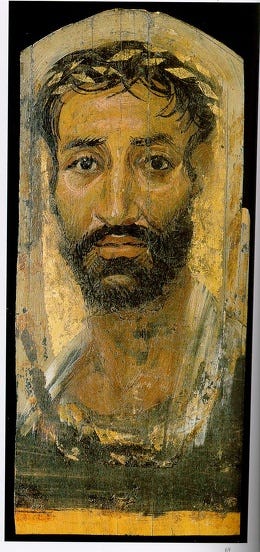
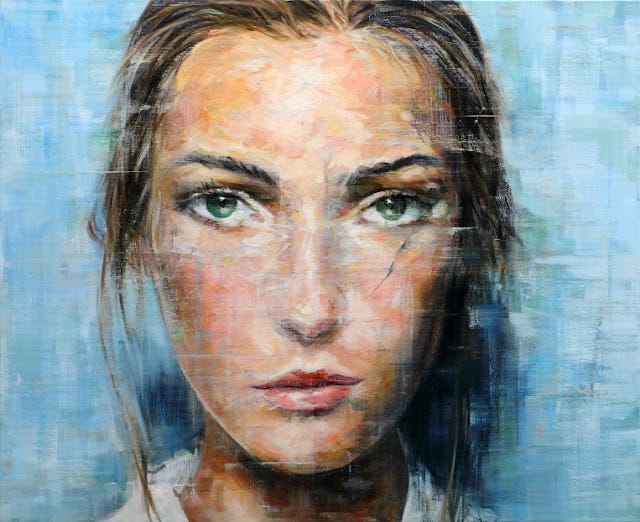
Fayum Portrait, 200 C.E. / Untitled portrait by Harding Meyer, 2015 C.E.
Consider the dizzyingly diverse emotional expressions we all apply via our affect by using exactly the same basic ingredients: two eyes, a nose, two ears, a mouth, and the landscape in which they are all situated. Identical and yet so distinctive as to be vertiginously vital to their existential character, since our inherent being in the world is so immediately conveyed through something so subtle, so involuntary, that we barely register its importance. To the painter of portraits however, across multiple eras and styles, as illustrated so convincingly by both Bailly and Hare in their respective books, the face is an entire constellation of meanings. As the reveries in these two studies further illustrate, a person’s face, though not essential to our appreciation of their personality or works in the world, is of course totally central to their cultural identity, one which can vary drastically, but is tied also simply to our shared integral human identity, which never does or can. And any text that accompanies that portrait, whether it’s a didactic panel on a museum wall or something the artist has inscribed adjacent to the actual image while making it, tell us a story, a fabula. A face asserts itself into our attention immediately, with even the most placid and unexpressive visage being utterly revealing about the person behind it. Or so we might imagine. And cultural continuity, within the time zones of a single culture as well as across multiple cultural borderlines, is precisely what makes the content overlap between Bailly and Hare’s books so fascinating, especially since one of Hare’s areas of interest by happenstance includes the portraits of two Egyptian pharaohs from the nineteenth to eighteenth centuries BCE. What is thus established, by two separate authors in two separate texts, is a notion that is central to appreciating the wide and diverse spectrum of stylistic formats used to express a single underlying (one might almost say subterranean) core human psychological content: the existence of a collective unconscious as extrapolated by Carl Jung, and the overriding element of the archetype in the lives of us all. That shared unconscious is the source of all our actions and our oddly similar dreams and nightmares along with the symbols contained in both, and that archetype is the shared allure we have with our binary personas, in this case the absorption with depictions of the human face.

The marriage of photo-chemicals and pigment achieved an apotheosis in the magnificent portraits of Andy Warhol, as evidenced by his reverential pop take on Marilyn in 1963.
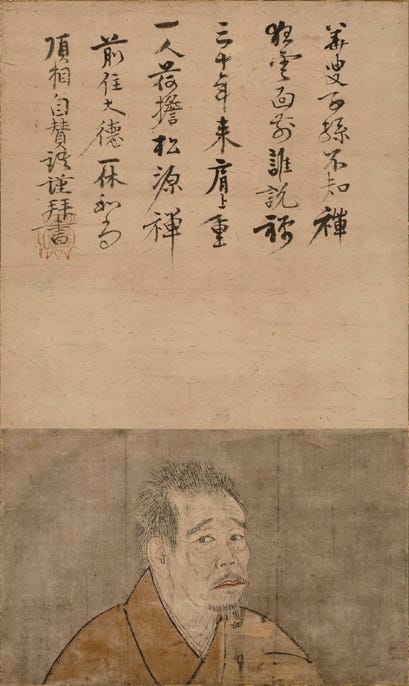
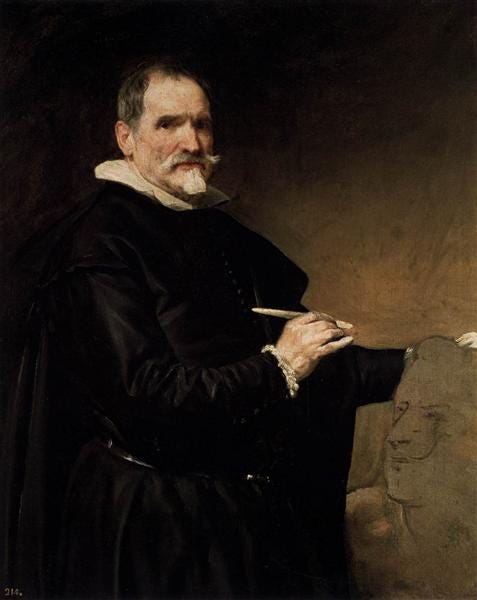
Motsurin Joto, 1492 / Velazquez, 1635
The portrait of Zen Master Ikkyu by Joto and that of the sculptor Juan Montanes by Velazquez are examples of two distinctly different depictions of a human face, one of which also contains a written text sharing the space of the image and given an equivalent content value that holds a special allure for Tom Hare in his comprehensive study Out of Character: Writing on Portraits. His specific interest is about both writing on the portrait itself as well as writing on the portrait, as in about it, conducted by the aesthetic explorer examining shared elements of emphasis by cultures which are otherwise separated by both space and time as well as language and beliefs. As he positioned his intriguing course of study: “Portraits often claim a revered place in worlds remote from their origins, but they also risk anonymity unless accompanied by written supplements announcing who they are and how we are invited to engage with them. Without such contextual information, portraits risk fading into obscurity across generations. A picture may contain a thousand words, as the saying goes, but a portrait, being a picture, still needs words to survive beyond its generation.” Tom Hare is Professor of Comparative Literature at Princeton University. He is the author of ReMembering Osiris: Number, Gender and the Word in Ancient Egyptian Representational Systems and Zeami’s Style: The Noh Plays of Zeami Motokiyo. Without of course needing to or intending to reference his fellow Princeton author on portraiture, he touches on a similar recognition of what all the varied expressions of facial reality communicate to us about the continuity of this archetype. “The study of portraits and the writing on them is unapologetically comparative. It grows from the conviction that there are elements of common interest among its objects of study, both because of the ways they were brought into being and also because of the insights we gain in engaging them together, despite daunting distances in time, space and cultural context.”
This aligns strikingly with Bailly’s assertion that “I have not questioned that the Fayum portraits are funerary portraits, what we might call portraits-towards death. The structure of mourning is implicit in pothos (longing or desire in Greek mythology). The tomb was, after all, the final destination of all the recovered portraits…There is a more certain, Roman source attesting to the portraits’ funerary-domestic function. We know that the Romans displayed in their atria the imagines of their ancestors, wax casts of the faces of the dead that were periodically paraded during funeral processions. These were indeed death masks.” Which also aligns seductively indeed with Hare’s queries about actual death masks and whether they can even be called real portraits (as real as their source may be) since there is no element of artful representation or craftsmanship present, apart from the desire to memorialize a hyper-realistic likeness. “And this holds true for life masks similarly, because the creation of such objects imposes a static expressionlessness on the subject under the mold’s matrix while it sets. More importantly though, life masks and death masks are not representations of subjects in the same way painting and sculpture are. With the death mask ‘representation’ is of a vague character. Other kinds of masks are worth mentioning here, masks that bear no indexical relation to a known subject. Wonderful masks were created for the art of Noh drama for example. Most of them represent human beings but they are not portraits….Of all the claims made about what constitutes a portrait, the most problematic holds that the true portrait should tell us something about the character of its subject.” That observation is intriguing, since it calls into question one of the most commonplace fixations of the painters of every era: the presentation of the artist’s own face in a self-portrait. Both Rembrandt and Van Gogh for instance, were well known to have veritably obsessed with their own faces, as was Picasso later on. We will have to leave it to the psychoanalysts among us to surmise the true reason for this predilection, while we, whether admirers, scholars, critics or historians, can be content to marvel at the sheer virtuosity of painters with a seemingly endless array of multiple faces, all belonging to them.
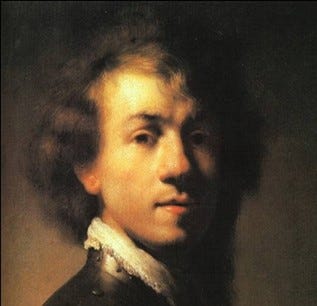
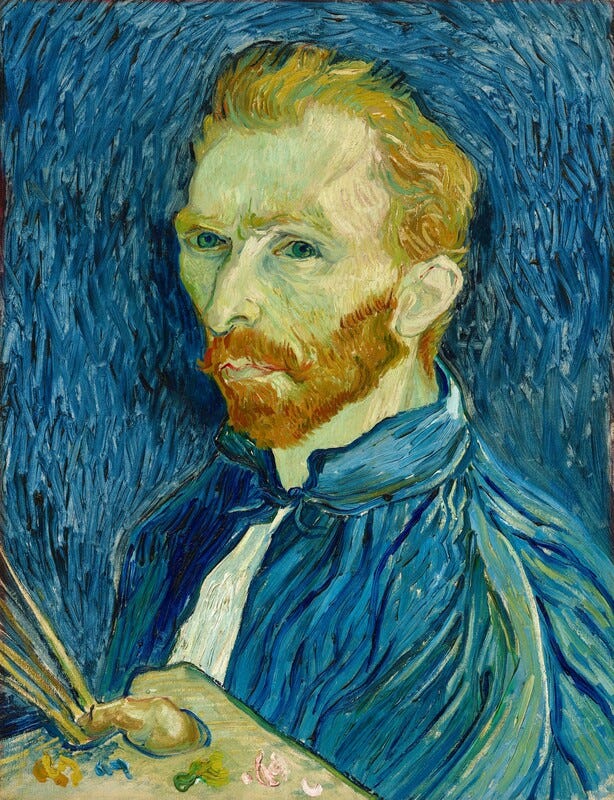
Rembrandt, 1639 / Van Gogh, 1889
These two new books, when their splendid illustration plates are examined before during and after reading the history that chronicles them, therefore also feel as if they may be excised members of a movie montage, apprehended as individual frames of film in a documentary study of the human face. In addition to being an archaeologist of the face, both these erudite authors also appear to be a cartographer of facial expressions themselves while deftly unearthing the emotions below their aesthetic surfaces. Therefore it follows that each of these portraits is also a map of the face of a person, real or imagined, which if followed carefully can lead us directly to the heart of their character. One can indeed call these marvelous portraits numinous, insofar as they seem to embody spirits, the Roman origin of the word being numen, or nod, as in a divinity nodding in recognition towards us. In the end, maybe a painter can convey something more physical and spiritual through his or her interpretive skills than a photographer could ever hope to trap with a mere lens. The organic and analog lens available to painters such as those that Tom Hare and Jean-Christophe Bailly explore and share with us in their splendid history of portraits for instance is still a superior tool for transmitting the basically surreal nature of our faces, since that unique lens is a marriage of the artists’ eyes and their hands.
I tend to enjoy the concept of facescapes not only because it references the human landscape but also because as a neologism it provides a pleasant and poetic pun: the same way a fire escape saves us from a burning building, these face-escapes also save us from the mythical accuracy of photography. Some artists have discovered that the human face is also a landscape and they treat it accordingly, as a spatial zone which can be explored, mapped and mined for seemingly endless meanings. They embrace the facial landscape in a way that captures our attention while freezing our gaze at the same time. Simply put, the landscape of the painted face is something so captivating that no amount of photography can ever endanger its immediacy or efficacy. However I must also admit that the genius of Warhol was such that he combined photography, printing and painting in the portraiture format to such an integrated degree that he became one of the most important and influential artists of the 20th century.
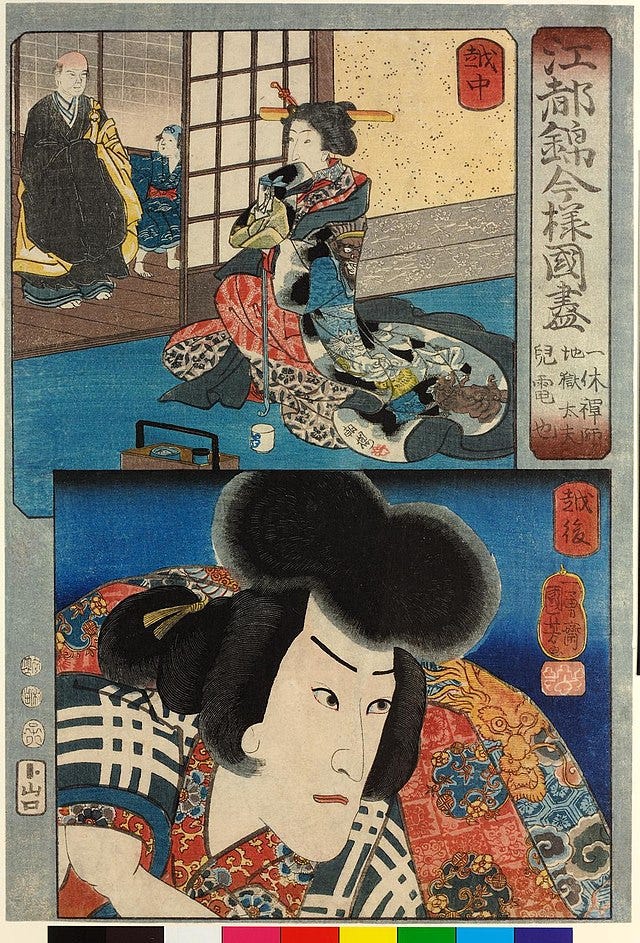
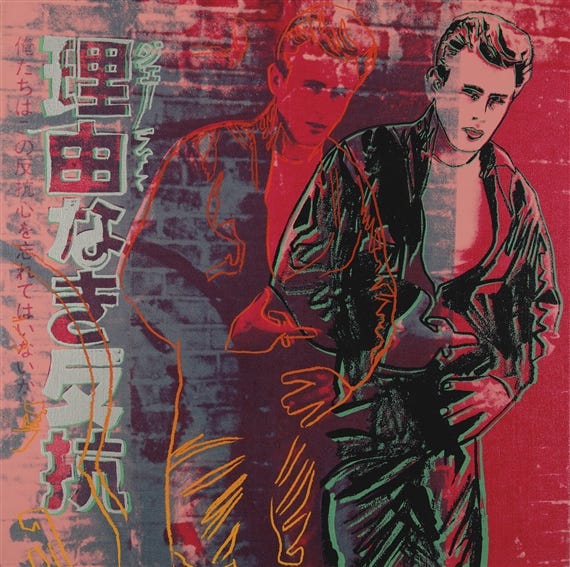
Ichikawa Danjuro, 1881 / Andy Warhol, James Dean 1963
Thanks Donald. What a great overview of the Art of the Face. It’s something that I’ve never thought about much. I suppose it’s so easily taken for grated because we see it constantly. I will admit, though I do remember those portraits that seem to dig so much deeper into the psyche of the person. You always pick rather unique subjects to ponder. And write about.