
Doris Lessing (1919-2013)
The Convention Cracker

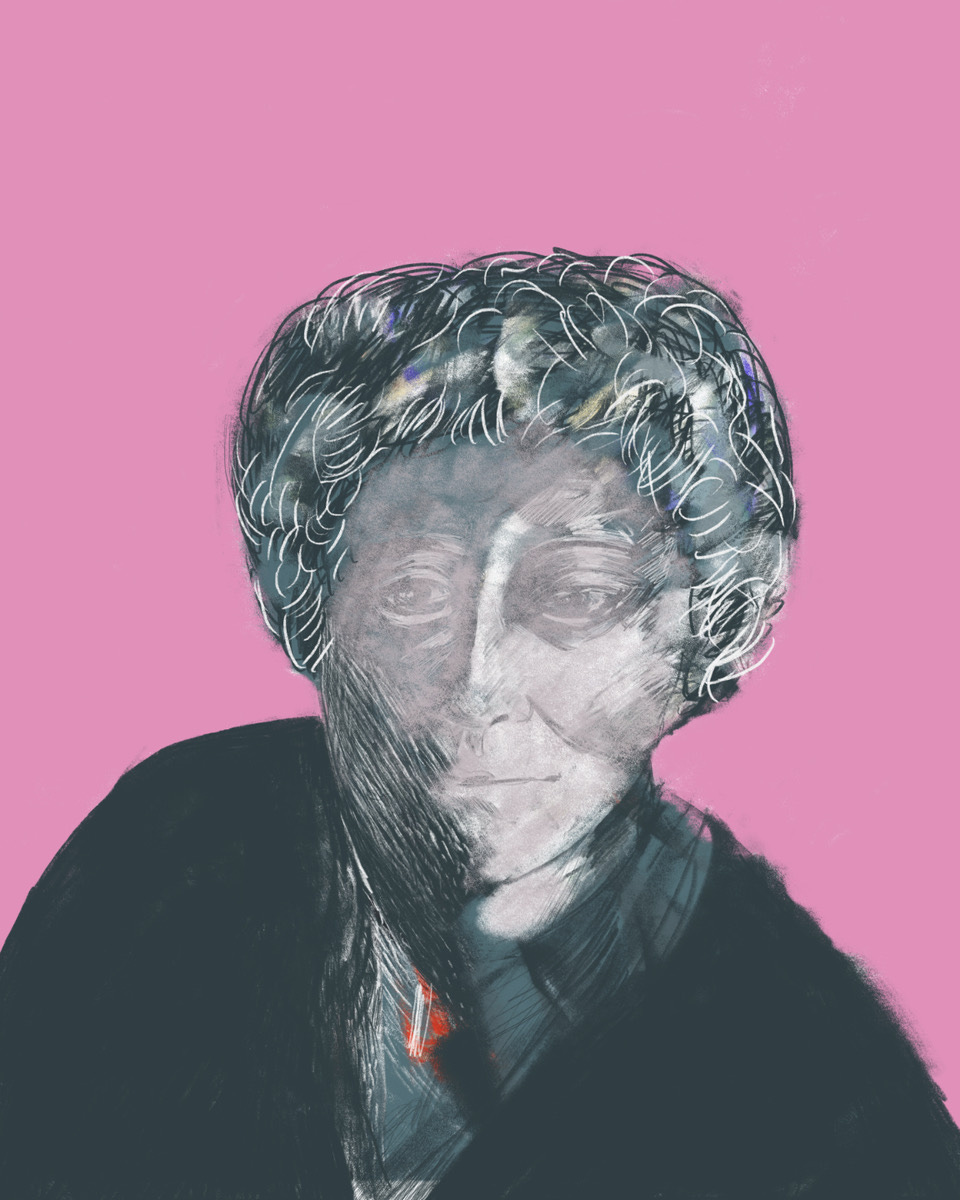
Portrait of Doris Lessing by Lance Austin Olsen
“Art is the mirror of our betrayed ideals. There is no doubt: fiction makes a better job of telling the truth.”
Doris Lessing
I’ve always been a little perplexed when well known authors don’t just take some fellow writer to task for this or that book (without even assuming the temporary mantle of literary critic, as John Updike did so gracefully and effectively for many years) but they actually proceed to trash one author or another to such a degree that they appear to call into question that author’s right to write at all in their own chosen literary voice. Okay, I’m not a little perplexed by this, I’m utterly baffled by it. Especially when the writers in question, Doris Lessing being cast as the innocent critiqued victim and Joan Didion leaping all too enthusiastically into the role of almost sadistic complainer, are both so accomplished as to make the readers of Didion’s essay on Lessing contained in her otherwise splendid anthology The White Album (which was published in 1970) scratch their heads in collective wonder. We’re all of course quite used to certain testosterone-driven male authors attacking their peers in an over the top manner, with Ernest Hemingway being perhaps the prime example of this degree of self indulgent literary assault. His attacks on fellow writers (one could barely call them critiques) are the stuff of his gun-loving egomaniacal legend. Hemingway, who once claimed that every writer is in much of his work, earnestly believed that only Joyce’s character of Bloom saved Ulysses from being dully autobiographical.
Most of the cruelest complaints Hemingway made, according to Updike, were in his voluminous letters, which were a fountain of harsh and rabid put-downs: Thomas Wolfe was a one-book boy, a glandular giant with the brains and guts of three mice; Scott Fitzgerald was a rummy and a liar with the in-bred talent of a dishonest and easily frightened angel; Sherwood Anderson was a slob; Gertrude Stein started taking herself too seriously; Faulkner has the most talent of anybody and he just needs a conscience that isn’t there, no man can write half-whore and half straight; Dos Passos was a second rate writer with no ear; Edmund Wilson works hard at being honest but has no true honesty within himself at all. Eventually of course, and sadly enough, Ernest had the modicum of good taste to reserve his harshest criticism for himself, although he chose a most lamentable method of doing so. But it still baffles me that Joan Didion, an excellent essayist who more or less invented the new personal journalistic style in the 1960’s (along with Mailer, Capote, Wolfe, and Thompson) by writing almost exclusively about her own flaws and neurotic foibles as a lens through which to share her astute experience of her volatile era, and was also an occasionally great novelist herself, should choose Doris Lessing to rake over her seething coals.
In the otherwise sterling collection of essays in her classic The White Album, Didion inexplicably launches into a tirade against Lessing in a way that seems quite unbecoming and certainly doesn’t rest well with her other cultural observations in that superb text. Known for her own blunt assessment of her perpetual private turmoils which constantly splash onto the mirror she skillfully holds up to the tumultuous decade that she seemingly barely survived, Didion has made a career of using her own character as a microscope for the excesses of that era. Which makes her heavy handed treatment of her fellow writer (who would eventually go on to win the Nobel Prize for Literature, the oldest writer to ever do so, at 87) all the more peculiar. “For more than twenty years now Doris Lessing has been registering, in a torrent of fiction that increasingly seems conceived in a stubborn rage against the very idea of fiction, every tremor along her emotional fault system, every slippage in her self-education.” But wait a minute, isn’t that precisely what you yourself have done so clearly in your own non-fiction Ms. Didion? That Lessing is, Didion acknowledges, a writer of consider native power, a natural writer, seems almost “a stain on her conscience”. “She does not want to ‘write well’: her leaden disregard for even the simplest rhythms of language, her arrogantly bad ear for dialogue. Even given Mrs. Lessing’s tendency to confront all ideas tabula rasa, we are dealing here with less than astonishing stuff. What we are witnessing here is a writer undergoing a profound and continuing cultural trauma, a woman of determinedly utopian and distinctly teleological bent assaulted at every turn by fresh evidence that the world is not exactly improving as promised.”
But Ms. Didion, isn’t that last bit of inventive a virtual succinct summary of the plot of your own novel, Play It As it Lays, as well as the personal emotional and psychological prescriptions of all the other essays in your own collection The White Album? In the end, it seems that, somewhat like Hemingway, Didion’s most ardent complaint is not that Lessing doesn’t write the way she herself does, but rather that Lessing’s approach is exactly the same as hers. Irony abounds hereabouts. Lessing’s chief crime appears to be that she is always looking for ‘answers’, or for systems that embody those answers, and that “She is scarcely alone in this possession is what lends her quest its great interest: the impulse to final solutions has been not only Mrs. Lessing’s dilemma but the guiding delusion of her time. It’s not an impulse I hold high, but there is something finally very moving about her tenacity.” That breathtaking shift, all the more paradoxical since Didion’s primary conclusion in most of her own work is that solutions of any sort are largely illusory and life remains bewilderingly inexplicable, veers conspicuously close to a compliment. And indeed, there is much to admire in Lessing’s stubborn tenacity and search for meanings and the belief platforms which might present them. It’s almost as if Didion were envious of Lessing’s persistently hopeful belief that meaning exists somewhere if we can only survive long enough to acquire it, and that Didion’s own personal conjectures lead her to no such belief whatsoever, a lamentable fact which she seems to hold her elder literary peer responsible for not realizing.
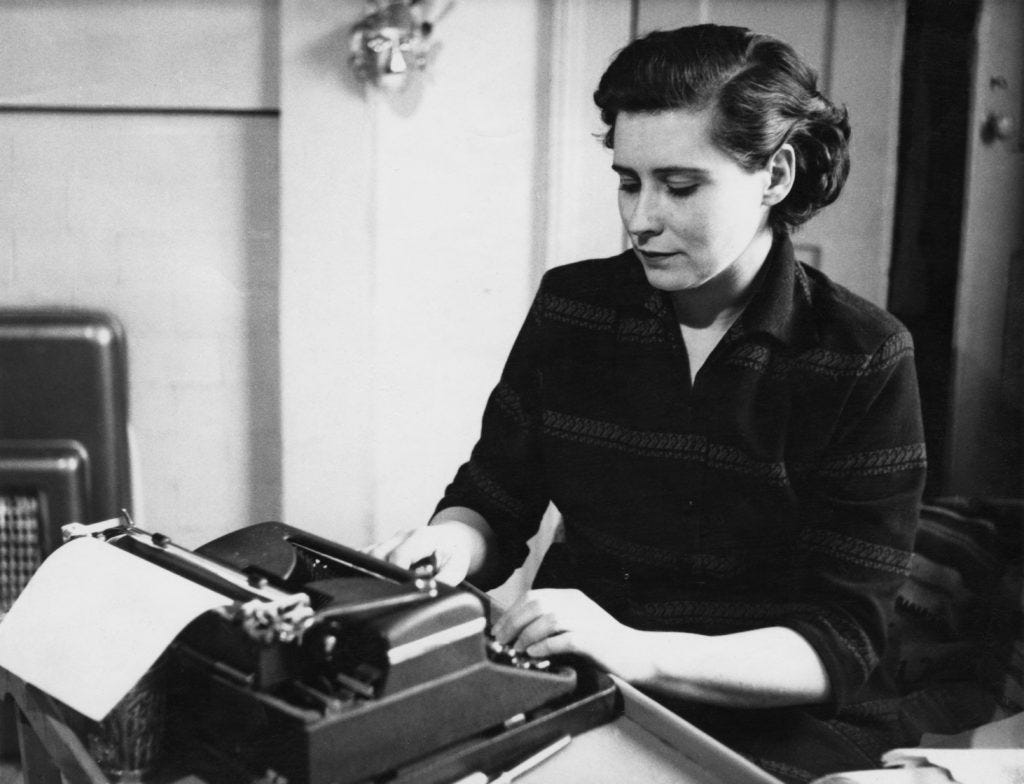
Doris Lessing, who was born to British parents in Iran before they moved to South Africa and finally to Britain in 1949, was described by the Swedish Academy awarding her Nobel as “an epicist of the female experience, who with skepticism, fire and visionary power has subjected a divided civilization to close scrutiny.” To be an epicist is to transform one’s experience, and one’s collective cultural experience, into a epic poem along the lines of Homer’s Iliad, and this is precisely what Lessing has always done from the beginning when she started writing at age 15 and began to be published in magazines.
From an alarmingly early age, she assumed an activist position in the context of what she perceived to be the injustices of the system, any system. This naturally provoked her involvement with a steady stream of revolutionary minded colleagues, from feminist to political. She always performed herself as a larger than life committed persona, to the eventual chagrin of some, including the intelligence gathering government venues such as MI5 and MI6, which compiled a surveillance dossier and on her twenty year long participation in a variety of Communist affiliate organizations. As an active opponent of nuclear arms globally, as well as the apartheid system in South Africa, which lead to her being banned in that country from 1956 onward. That year, however, with the brutal Soviet invasion of Hungary, she left the Communist Party and became increasingly occupied with science fiction and spiritual pursuits, including the practice of Sufism. She embodied herself as a persona most convincingly, demonstrating that what is required of engaged writers is a creative technique for both soliciting and eliciting a steady stream of awesome revelations. These are often disguised as everyday occurrences which go unnoticed by an otherwise preoccupied species such as ours. Unconscious objectivity was waiting all along to be used by everyone, she asserted, yet it was only accessible to those who, either voluntarily or against their will, were precariously perceptive enough to surrender to it. Such as novelists like Doris, and initially in narratives like The Grass is Singing, 1950.
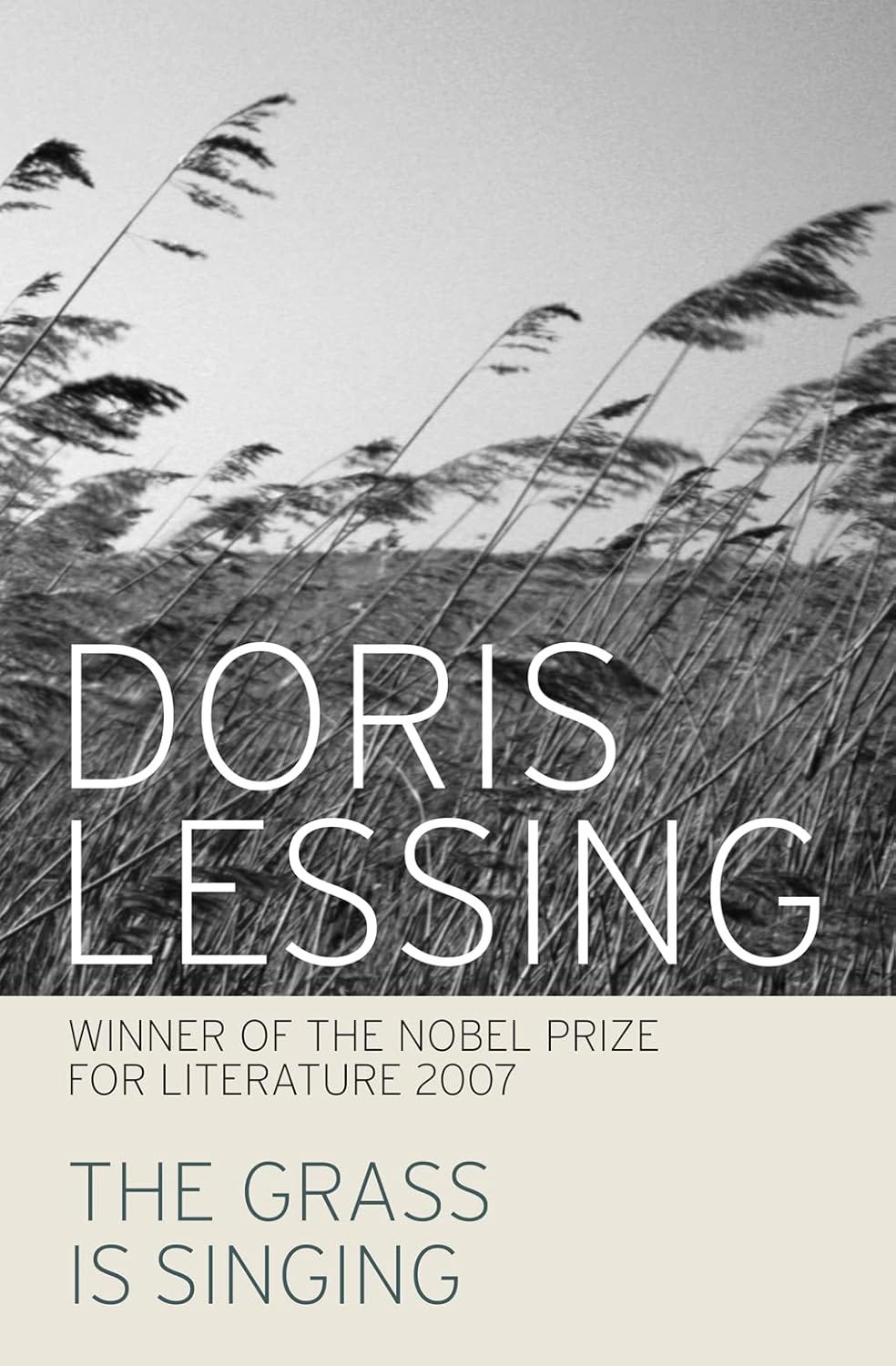
Doris Lessing brought the manuscript of her first novel with her when she left South Africa and came to England in 1949. When it was first published it created an impact whose reverberations we are still feeling, and immediately established itself as a landmark in twentieth-century literature. Set in what was then Rhodesia, it tells the story of Dick Turner, a failed white farmer and his wife, Mary, a town girl who hates the bush. Trapped by poverty, sapped by the heat of their tiny brick and iron house, Mary, lonely and frightened, turns to Moses, the black cook, for kindness and understanding. A masterpiece of restraint and realism, The Grass is Singing is a superb evocation of Africa’s majestic beauty, as well as an intense psychological portrait of lives in confusion and, most of all, a passionate exploration of the ideology of white supremacy. In order to change the world, it does seem to demand a certain suspension of the customary faculties with which the business of the world is conducted. Thus it ushers us into a different seat in the theatre: one stripped of all extraneous accoutrements, and provokes the peeling away of distracting appetites or superstitious senses. From that fresh new point of view (and you) though suddenly scary beyond belief (precisely because it is beyond belief) she showed us that it is also truly splendid in the spectacle of its sudden clarity and distance.
The objectification of chance, as in The Golden Notebook, 1962, was a groundbreaking penetration into a deceptively simple premise and narrative which arrests the reading mind, but only long enough to embark on the kind of extended reveries later contained in the five volume series of novels that followed called Children of Violence, and to entertain the basic attitudinal changes required to alter the landscape of our behaviour. The final novel’s dystopian ending, off-putting to some readers who prefer happy endings in their literary diversions, involves a Britain that has become uninhabitable due to an unspecified catastrophe. It was clear to anyone paying attention that she was sliding slowly but surely into an Ursula Le Guin territory of science fiction blended with feminist philosophy. The unconscious origins of all love, passion, poetry, mythology, religion, philosophy and politics: all the human sicknesses and all the humanist cures, would culminate in Shikasta, 1979 (her title comes from a Persian word meaning ‘broken’) which is such a surreal morality tale that it stuns us into submission. It is yet another five novel sequence examining a fictional planet through an extended meditation on its prehistory, its degeneration and its eventual disruption in an apocalypse. The shift from linear fictional narrative to science fiction and mystical themes was distressing to readers more familiar with her earlier diverting tales of relatively normal people in extraordinary circumstances. To those readers she was offering an invitation to what she called ‘inner space fiction’, a style she had embraced earlier with Briefing for a Descent into Hell in 1971 and Memoirs of a Survivor in 1974.

What is required by her tough minded but warm hearted tales, which in the end came to be termed ‘anti-novels’ or ‘architectonic novels’, is a sustained curiosity, some undefined appetite for meaning before a next to last plunge into a kind of marvelous maelstrom. Her books take us on a journey, one where the sun’s breadth is that of a human foot, far away from our tedious existential ennui one merely endures, and into the arms of everything which awaits us in between both life and death and their traditional signposts. Granted, eventually a baroque exhaustion of sorts emerges, expands, engulfs, and evolves across the face of all and everything, but is that not a small price to pay for access to such an exalted and ineffable state as meaning, she asked? As explicated in her inner space stories, eventually the more or less present form of human body and skin took shape during our slow progress from cell to computer, after many experiments to find the best and most suitable design for a mortal coil. Not all such story-stones simply allow themselves to be picked up quite so easily, some resist the grasping hand and its comforting hostage of hope, as if to protect the barking noises frequently found beneath stones in general, and such rare stories as hers in particular. Of course, this process described by Lessing (and so totally misunderstood by Didion) as a slow but steady march towards a predetermined end, may still be going on right before our jaded eyes. And after as long a period of time in the future has passed as has already been experienced by us up until now, our bodies may actually turn into something as unrecognizable to then as we may have been to the ocean dwelling cells who eventually became us. For there is an ocean inside each of us, Lessing confided to those willing to listen, one that only a few hapless vacationers are ever fortunate enough to discover, let alone to navigate.