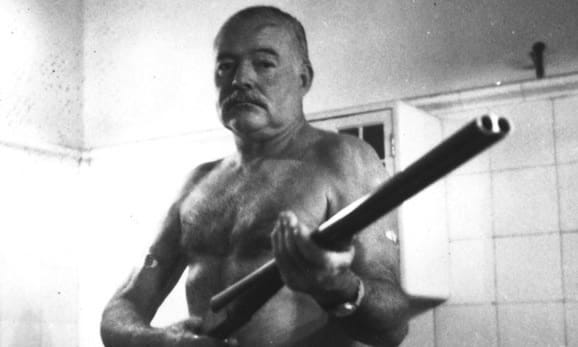
Being Ernest
Somebody had to do it.

Transposed Heads is a collaborative limited edition art book-work comprising literary profiles of major international authors, with words by critic Donald Brackett and images by artist Lance Austin Olsen.
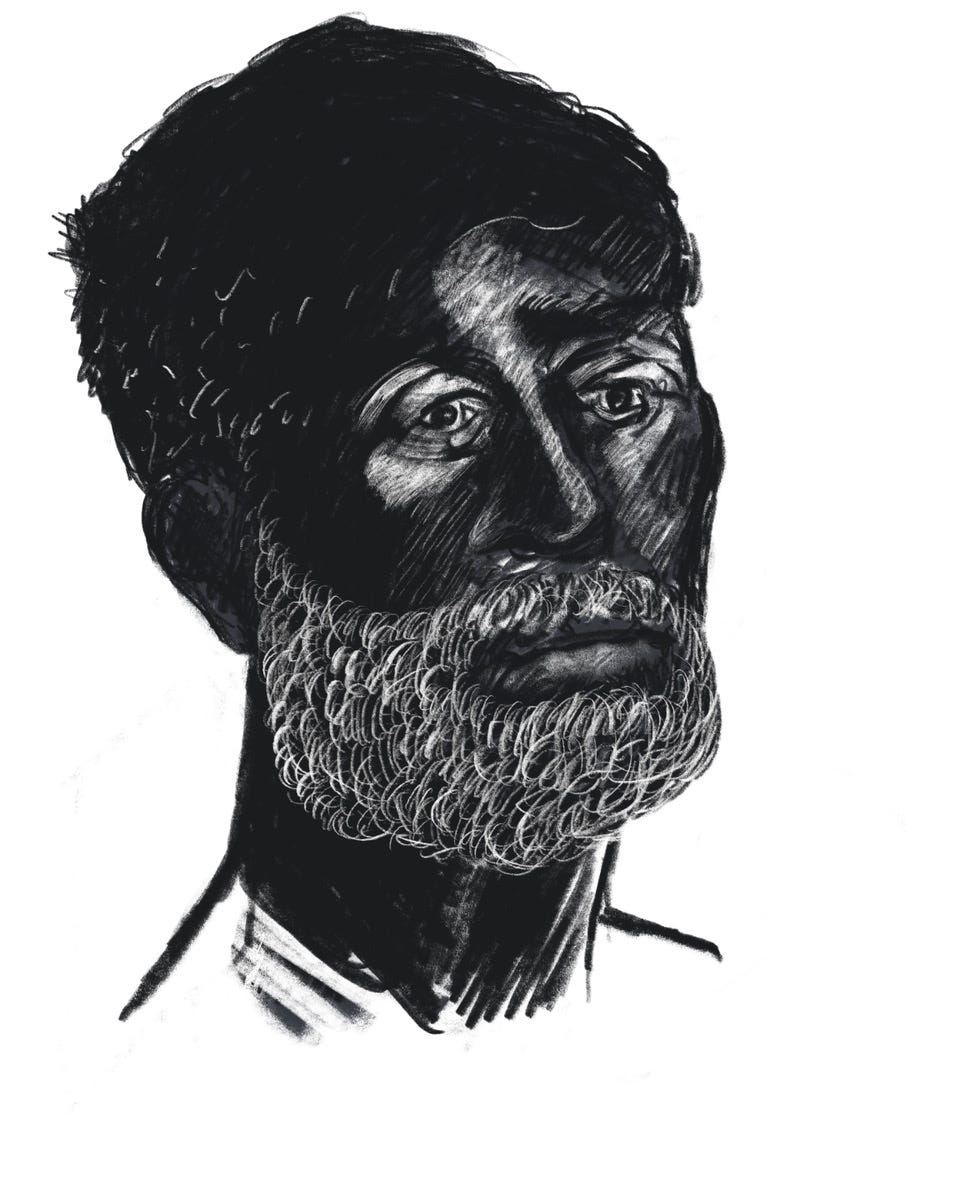
Ernest Hemingway (1899-1961) The Newspaper Man
“There is no friend as loyal as a book. There is nothing to writing: all you have to do is sit down at a typewriter and bleed.” E.H.
Just as our favourite American poet Uncle Wallace Stevens pointed out our shared literary paradox by remarking on a “metaphysical street in the physical town.”, Uncle Ernest once wrote the shortest story ever composed by a newpaperman: “For sale, baby shoes, never worn.” Long before his sad ending, he had already taught us to hear the music of the axes in the emotional forest. Most clearly in The Sun Also Rises, 1926, and A Farewell to Arms, 1929. Since nothing we say about the Void actually can tell us anything about it, some solutions are just as puzzling as the original problem they appeared to solve, or at least attempted to. Like birds of prayer, we sit waiting on branches for calamity to fall from the sky and sure enough, fall it does, in great gooey blobs of epiphenomenal and lamentable expedients. No, he did not write for love of humanity, but from the perverse urge to procure for our thoughts a separate and tangible existence in the world. At such a point, opposites really do cease to be contradictions. And his life was a palpable contradiction writ large: super sensitive yet also unable to overcome his own character armor.
We have all been manufactured by fiction itself, he seemed to tell us in For Whom the Bell Tolls, 1940, chiefly in order to serve reality in some vague and mysterious manner. A realm of silence, gesture and immobility. One is forced to keep perfectly still out of the quite logical compulsion to witness the slow erosion of the dream. The dream decays before our dreaming eyes. Alarming holes appear on the other side of being if it is observed too clearly. Still one stares, just as Papa stared, even as the central hole begins to expand from within each of us and eventually reaches outward to encompass everything outside. Eventually, the prosthetics are all abandoned, the vast artificial spine evaporates, and suddenly there comes an end to all surmise. Again, who in such a situation would want to hazard conjectures about the future? Not Ernest, an old man and his thoughtful words, frequently brilliantly expressed. Pensive to the end, the skin of stars in a skull bucket, white hot scraps of paper turning brown in the sun indoors, the ghostly presence of gravity caressed by light, since that which is touched is not to be taken as a toll. Like Beckett in The Unnameable, Hemingway told us he couldn’t go on, but he would go on, if only to provide us with existential entertainment of the highest order.
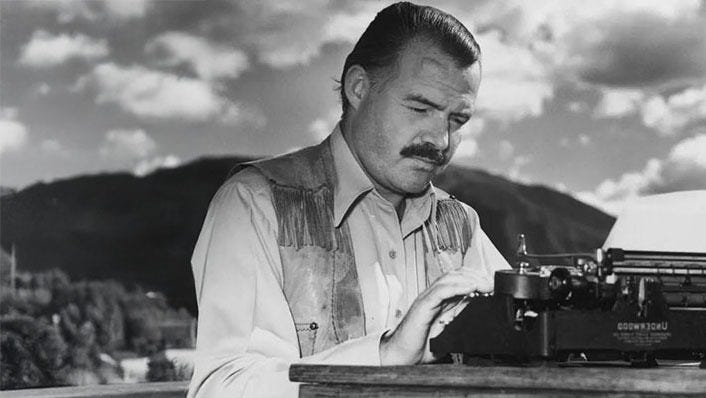
So, the solitary card-player who sits inside smiling tears quietly writing the numbers one to ten for the air alone, apparently dipped into diamonds. Utilized most fully at night awake, with any colour howling across a canvas painted in invisible ink, a shadow crosses the room slowly and anything that moves in that field is in big trouble under the shell of another sky. Appetite impels forward motion. It always does. Until it stops. Then it can’t anymore. So it stops, sometimes with a whimper, sometimes with a big bad bang.